
The Fed Finally Folded: A First Hike Since 2023 Meets 5% Yields and an AI Scare
The Fed Finally Folded: A First Hike Since 2023 Meets 5% Yields and an AI Scare
Three months ago, Fed Chair Kevin Warsh told markets not to expect much forward guidance. This week, with the 10-year at 5% and oil topping $108, he gave them a dot plot pointing to more tightening ahead. That’s the story of the week in one sentence: a Fed that folded on transparency because the bond market forced its hand. Layer in the first Fed hike since 2023, a Bank of Japan hike to its highest level since 1995, a sharp AI-driven selloff that fully reversed by Friday, and an equal-weight S&P 500 now on its fifth straight losing week, and you have one of the more consequential weeks of the year.
Macro Catalysts: Warsh Folds, and the Dots Go Up
The dominant macro event of the week was the FOMC’s unanimous decision on Wednesday to raise rates by 25bp, the Fed’s first hike since 2023. Chair Warsh signaled further tightening may be necessary, citing broad-based inflation beyond just energy, and Kansas City Fed President Schmid backed the move, noting that inflation excluding energy has “also been running hot.”
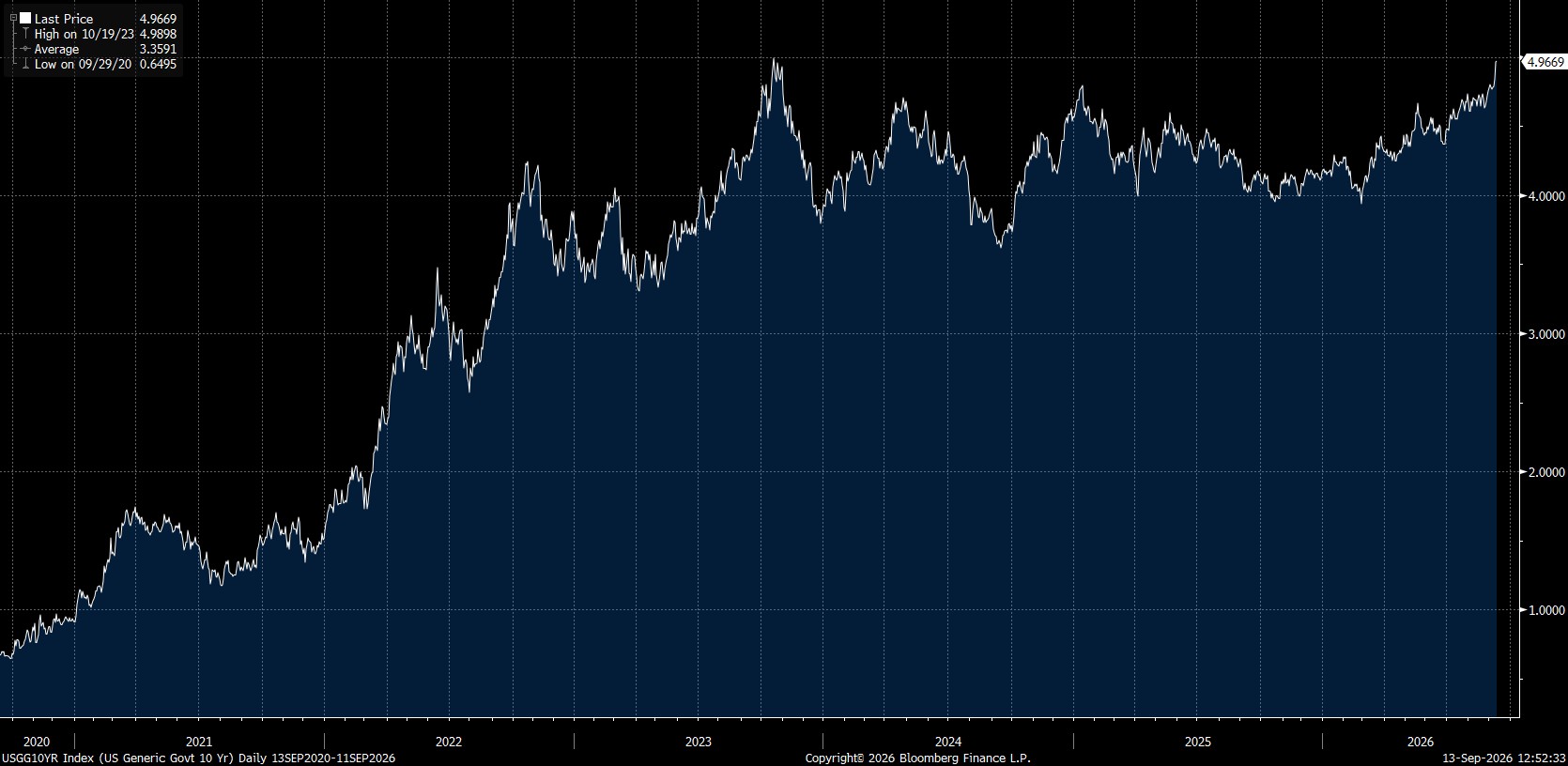
What makes this notable isn’t just the hike itself, it’s the reversal in the Fed’s communication strategy. Back at Jackson Hole, Warsh signaled the Fed wouldn’t offer much forward guidance. But between then and now, oil spiked on Iran-related tensions, inflation proved sticky, and the 10-year Treasury climbed all the way to 5%. Faced with a bond market that wanted clarity, the Fed folded: dot projections that barely moved from June to September have now shifted decisively higher across the board, and Warsh spent much of Wednesday’s press conference leaning into exactly the kind of guidance he’d previously downplayed.
Oil remained the key transmission mechanism behind all of it. Brent crude topped $106.8/barrel mid-week, up nearly 20% just in September, driven by Middle East supply disruption fears, including a critical Saudi pipeline that stayed offline following attacks. Oil pulled back late in the week after French President Macron called for a G7 meeting to discuss a coordinated release from strategic oil stockpiles, but the rally had already done its damage: it was the direct driver pushing 10-year yields back toward 5%, a level last seen in 2007.

WTI last 5 sessions.
The other major policy story was out of Japan: the Bank of Japan raised its benchmark rate to its highest level since 1995 and signaled further increases, a meaningful development given Japanese investors hold an estimated $2.5 trillion in US financial assets.
Markets also got a scare on the AI front early in the week. Reports that AI lab leaders, including comments from Anthropic’s CEO, were calling for a slower pace of AI development triggered a broad semiconductor selloff; Nvidia and Broadcom slumped, and a closely watched chip industry gauge fell roughly 5% Monday and Tuesday. The sector recovered sharply by Friday, with chipmakers leading the gains and the iShares Semiconductor ETF up 2.7% on Friday alone.

Asset & Sector Performance: Breadth Keeps Deteriorating Under the Surface
Headline index performance masked a genuinely volatile week underneath. The S&P 500 finished up just 0.42%, but that number hides a lot: the index fell to its lowest level since July on Wednesday following the Fed hike, before chipmakers staged a sharp late-week recovery. The Nasdaq Composite outperformed at +1.29% as tech recovered hard into the close, and the Nikkei 225 was the best performer among major indices at +2.40%, aided by yen dynamics and chipmaker strength in Asia. European markets lagged, the FTSE 100 fell 0.36% and the DAX fell 0.54%, weighed down by hawkish central bank signals, elevated energy prices with Saudi Arabia cancelling deliveries to European refiners, and political uncertainty in France.

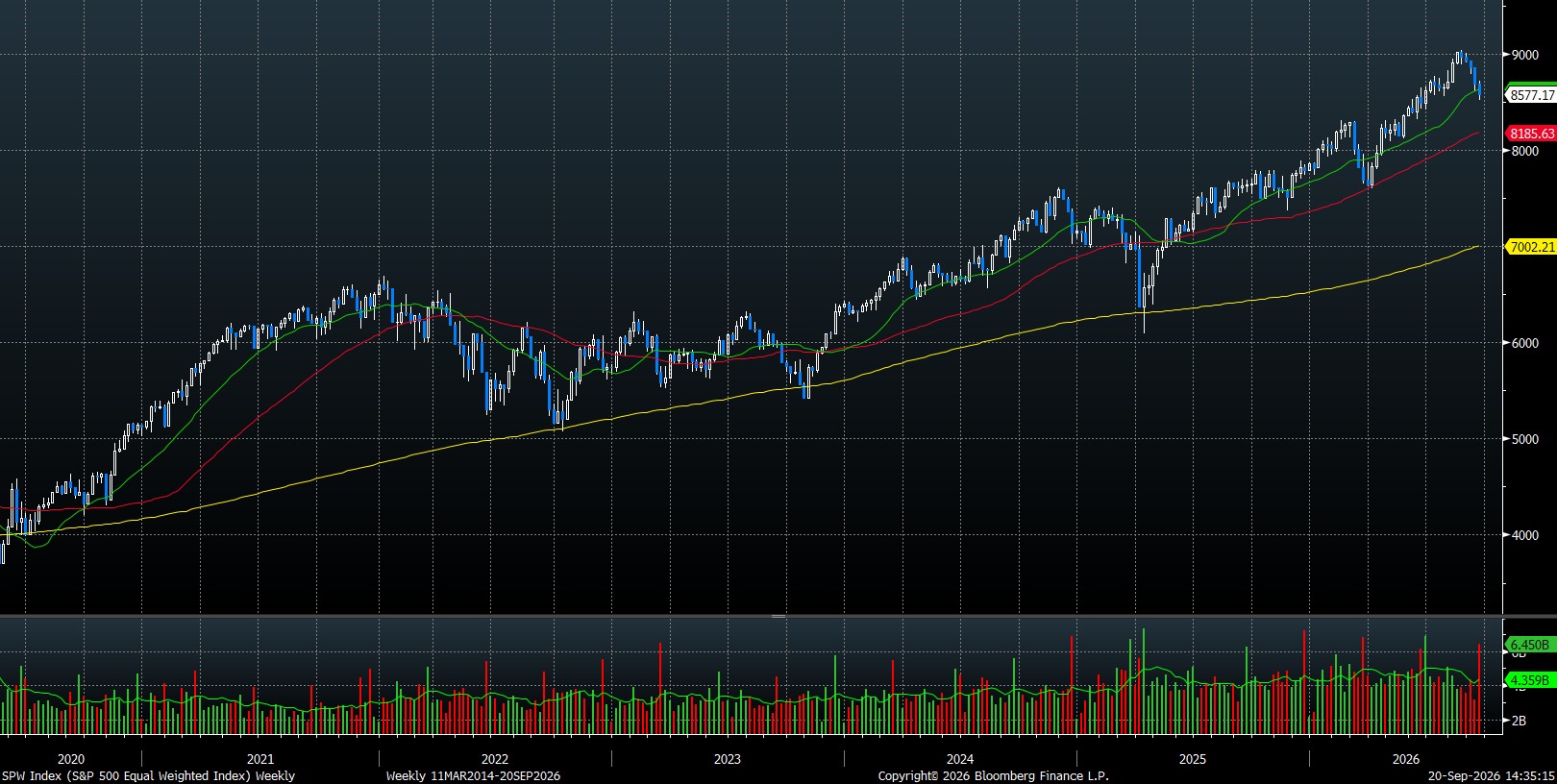
The number worth sitting with, though, is breadth: the equal-weight S&P 500 posted its fifth consecutive weekly loss, the longest losing streak since 2023, underscoring that the headline index’s recovery has been narrow and concentrated in large-cap tech rather than broad-based.

On single stocks, cybersecurity and crypto-adjacent names dominated the winners’ list: CrowdStrike (+15.0%) and Palo Alto Networks (+10.0%) led a broad cybersecurity rally, with Fortinet (+8.8%) also featuring prominently in both the S&P 500 and Nasdaq 100. Semiconductors rebounded sharply after the early-week AI-driven selloff, with AMD (+8.5%), SanDisk (+9.7%), and Intel (+5.5%) among the names recovering hard by Friday. Strategy (formerly MicroStrategy, +17.5%) was the Nasdaq 100’s biggest gainer, tracking Bitcoin’s move back above $81,000, while Coinbase (+10.8%) also benefited from the crypto rally. Generac (+10.9%) was a standout individual story, soaring Thursday after a reported Amazon deal.
The losers’ list told a different story: financials, telecom, and rate-sensitive sectors bore the brunt of the Fed hike and a 5% Treasury yield environment. JB Hunt Transport (-13.4%) was the S&P 500’s worst performer, falling sharply Tuesday as financials and cyclicals sold off ahead of the Fed decision. Goldman Sachs itself (-8.5%) was cited as one of the largest drags on the index, with financials broadly among the biggest post-hike losers. Charter Communications and Comcast both fell roughly 10%, consistent with rate-sensitive, high-debt sectors underperforming as yields rose, and Constellation Energy (-10.5%) — a power/nuclear name — was pressured by broader energy-sector volatility and rate sensitivity. CoreWeave (-8.6%) gave back gains from the early-week AI selloff, and oilfield services and E&P names like SLB and Diamondback sold off despite the crude rally, likely on profit-taking and demand-destruction concerns tied to higher rates.
On a year-to-date and weekly industry basis, the pattern that’s held for months continued: Semiconductors, Cyber Security, and Energy remain the strongest year-to-date performers, while Homebuilders and broader Retail continue to struggle under the weight of higher-for-longer yields. Banks have also shown signs of cracking recently, down 7–8% from recent highs alongside cautious Q3 commentary from names like UBS, a development worth watching given banks’ traditional role as a “second derivative” read on the broader economy.

KBE Bank ETF down -8.5% from recent highs.
Rates & Fed Expectations: 5% Is No Longer a Ceiling
The Treasury sold off sharply mid-week, with the 10-year yield hitting 5% on Wednesday, a level last seen in 2007, before partially recovering Thursday as oil prices eased. A global bond selloff resumed Friday with bear flattening, French bonds leading European weakness amid political uncertainty and deficit concerns. It’s worth noting this isn’t a uniquely American story: most developed-market 10-year yields are up somewhere between 80–90bps year-to-date, suggesting markets are broadly repricing “higher for longer” inflation rather than punishing US policy specifically. China stands out as the exception, with yields actually coming down and the curve flattening by roughly 25bps.

Fed funds futures have moved decisively since Warsh’s first FOMC meeting back on June 17: the curve now points to another hike before year-end and as many as three additional hikes before this tightening cycle is judged complete, a dramatic shift in market expectations for a Fed that, only months ago, was signaling patience.
The dollar strengthened on the back of the hike, and EM currencies are on track for their worst week since May as a result, a reminder that Fed hawkishness doesn’t stay contained to US assets.
Volatility & Technicals
The VIX remains notably compressed, sitting below 15% despite the week’s whipsaw, every recent spike in volatility has been dampened quickly, both on a short-term and one-month basis. Wednesday’s VIX and options expiry could set up a modest volatility reset heading into quarter-end, though seasonality historically turns more favorable heading into October and midterm election years.
Technically, the S&P 500’s uptrend remains intact, “the trend is still your friend,” with the index still holding above its 50-day average despite Wednesday’s hiccup and the Nasdaq shows a similar, choppier version of the same picture, consolidating since roughly May with a brief dip in late July. The Russell 2000 continues to underperform, as small and mid-caps remain the most exposed to rising yields; a further 5% downside from here wouldn’t be surprising on the chart. Gold, meanwhile, is sitting in what amounts to no-man’s-land technically, no clear edge in either direction, while Bitcoin’s push back toward the $82,000–$83,000 level stands out as one of the week’s more speculative, lower-quality rallies: the week’s broader winners skewed toward unprofitable tech and high-beta retail-favorite names, a pattern that historically hasn’t aged well.
One flow data point worth flagging: US equity funds recorded roughly $70 billion of inflows this week, among the largest in a long stretch, even as a widely-read monthly report from Citadel cautions that the back half of September has historically been a seasonally weak stretch for markets.
Earnings Checkpoint
It’s a light week for earnings, with Costco reporting Thursday as the headline event alongside a handful of homebuilders worth watching closely given how poorly recent housing data has trended. The SPY weekly straddle is currently pricing an implied move of roughly +/- 1.2% into next Friday, in line with the market’s recent range-bound behavior even through a first-hike-in-three-years event.
The Week Ahead: Flash PMIs Are the Data Point That Matters
- Wed 23-Sep: US Flash PMIs — the most closely watched release of the week, offering the first read on economic activity following the Fed hike and amid the ongoing oil shock. Eurozone and UK flash PMIs the same day will show how the energy shock is feeding through to European business activity.
- Thu 24-Sep: Germany Ifo Business Climate — a key sentiment gauge for Europe’s largest economy, plus US New Home Sales and Building Permits.
- Fri 25-Sep: US Durable Goods Orders and University of Michigan Sentiment.
Central banks stay in focus even outside the Fed: the Swiss National Bank and Sweden’s Riksbank both have rate decisions due, with both expected to hold. Fed speakers will be out in force all week explaining the hawkish dots, and markets will parse every comment for signals on October hike probability, which currently sits around 50%.
On the geopolitical and energy side, watch for any developments on Macron’s proposed G7 discussion around a coordinated strategic oil reserve release, along with any escalation or de-escalation in Middle East supply disruptions, still the single biggest swing factor for oil, inflation expectations, and rate paths globally. A reported meeting between China and the US on Thursday is also worth watching, particularly given China’s recent efforts to secure oil supply amid the Iran situation.
The overarching question heading into next week: does the PMI data confirm economic resilience, or does it start to show that the combined weight of higher rates and elevated energy prices is beginning to bite? That answer will shape the entire October Fed hike debate.
Trader’s Note: A Fed that folded on forward guidance because the bond market forced its hand, an AI scare that fully reversed within days, and a market where the “winners” skew toward high-beta and unprofitable names is not a market screaming conviction, it’s one screaming caution dressed up as calm. With the equal-weight S&P now five weeks into a losing streak and flash PMIs landing before next Friday’s close, breadth and growth data matter more here than anything the headline index is telling you.
Stay Connected
To Register to the Webinar How to Trade the Mid term Elections:
https://us02web.zoom.us/meeting/register/ejQuWdYCQ4SQFcP_mvl8yg
Want to dive deeper or join the community?
📧 Book mentoring for Q4 2026: https://duponttrading.com/mentoring/
🎥 Access the 4×4 video series: https://duponttrading.com/4×4-course/
💬 Join the Discord: 30 channels of trading insights: https://discord.com/invite/Yf42SgAx7f
For any questions or to join our mentoring sessions, email us at Greg 📩 Contact: greg@duponttrading.com
Have a good Trading Week!
Sub Section Title Here
Lorem ipsum dolor sit amet, consectetur adipiscing elit, sed do eiusmod tempor incididunt ut labore et dolore magna aliqua. Ut enim ad minim veniam, quis nostrud exercitation ullamco laboris nisi ut aliquip ex ea commodo consequat. Duis aute irure dolor in reprehenderit in voluptate velit esse cillum dolore eu fugiat nulla pariatur. Excepteur sint occaecat cupidatat non proident, sunt in culpa qui officia deserunt mollit anim id est laborum.
Related Articles
Better Hike Than Wait: $100 Oil Forces the Fed’s Hand
Better Hike Than Wait: $100 Oil Forces the Fed’s Hand It was a…
VIEW POST
Dovish Thursday, Hawkish Friday: The Jobs Report That Flipped the Fed Trade
Dovish Thursday, Hawkish Friday: The Jobs Report That Flipped the Fed Trade It…
VIEW POSTTHIS POST

LEARN ONLINE TRADING TODAY. THE PROFESSIONAL WAY.
Let us solve the problem and confusion around trading and finance management, the right way.
ACCESS FREE LECTURESUBSCRIBE
TO OUR BLOG
To receive opinions, market research, and data analysis in the Financial Markets
ABOUT
DUPONT TRADING
As a Professional Trader/Portfolio Manager/Hedge Fund Manager for almost 20 years, I know that learning how to Trade/Invest is a non-ending learning curve. This adventure is extremely exciting but needs to be ridden carefully.
In January 2018 after receiving many requests, I decided to start my own mentoring activities.
In October 2019, I launched the 4×4 Video Series to help Investors profitably manage their portfolios. By sharing my ideas/experiences and offering education through the 4×4 Video Series, I hope I can help you becoming a better investor.

Students
Testimonials

K. (United Kingdom)
LEARN ONLINE TRADING TODAY. THE PROFESSIONAL WAY.
Let us solve the problem and confusion around trading and finance management, the right way.
Reader Interactions