
Better Hike Than Wait: $100 Oil Forces the Fed’s Hand
Better Hike Than Wait: $100 Oil Forces the Fed’s Hand
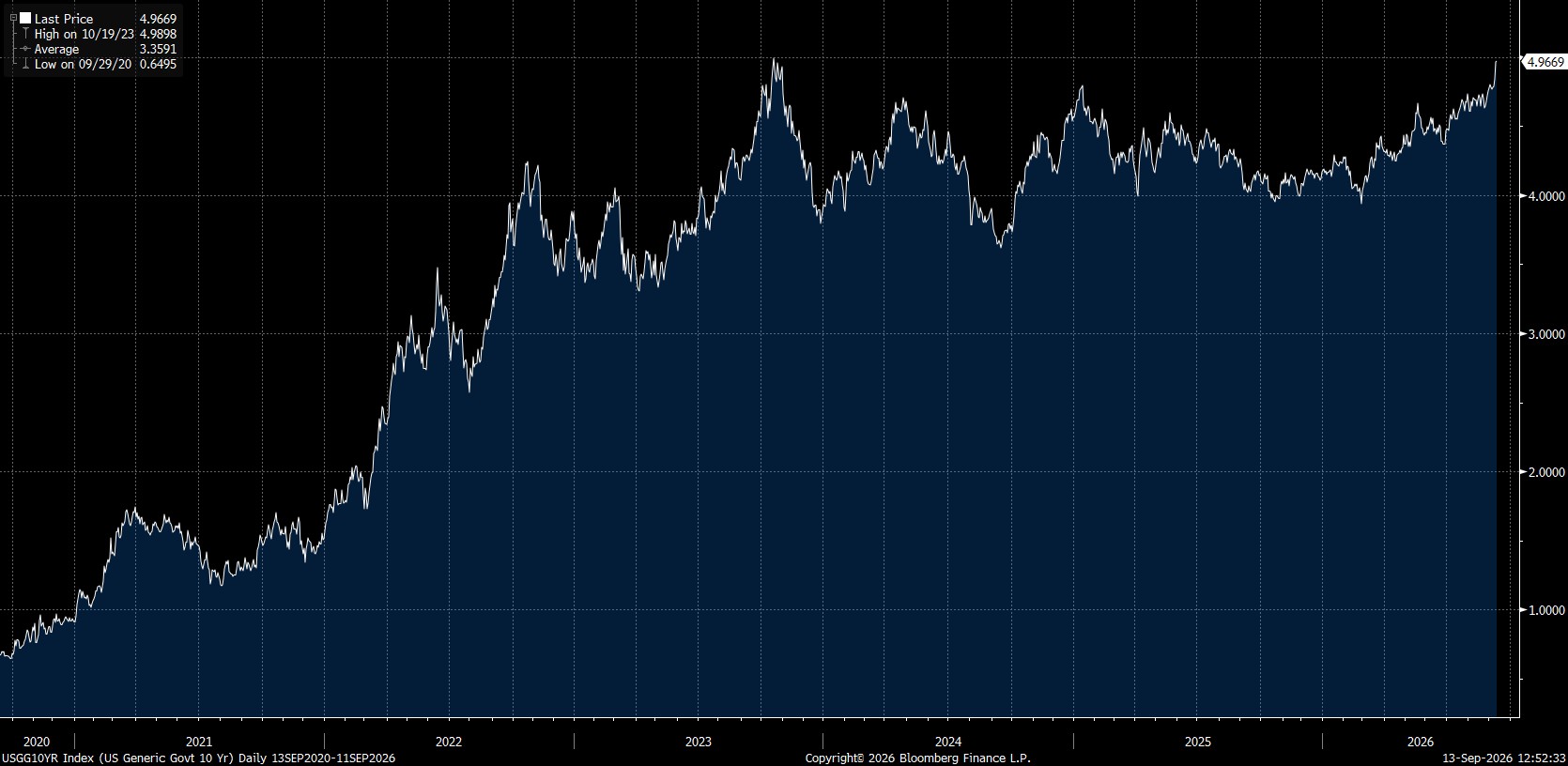
It was a genuinely risk-off week, and for once the culprit wasn’t the Fed, it was the Middle East. Attacks on Saudi energy infrastructure sent crude surging toward $100/bbl, reigniting inflation fears just as a hotter-than-expected August CPI print landed. The combination pushed the 10-year Treasury yield to within a whisker of 5%, its highest level since October 2023, and put a Fed rate hike firmly back on the table heading into next Wednesday’s decision. Underneath the index-level pain, semiconductors ripped while healthcare and consumer names got crushed. Here’s the recap, and why next week might be the most consequential of the quarter: three G7 central banks decide policy in three consecutive days.

U.S. 10 year.
Macro Catalysts: An Oil Shock Meets a Hot CPI Print
The dominant story of the week was crude. Escalating attacks on shipping and energy infrastructure in the Middle East, including the closure of Saudi Arabia’s East-West pipeline, subsequently traced to attacks launched from inside Iraq, sent WTI up roughly 9.4% on the week to around $100/bbl, with Brent trading above $105. That’s the kind of move that doesn’t stay contained to energy markets: it reignited inflation fears just as US core CPI for August came in hotter than expected at +0.3% month-on-month (versus a +0.2% consensus), with a record jump in wireless phone service prices cited as a key contributor.

WTI back to $100.
The result was a 10-year Treasury yield that surged to nearly 5%, its highest level since October 2023, while the 30-year touched 5.3%, the highest in nearly 20 years, according to Goldman Sachs. Their read: the combination of rising oil prices, a repricing of the Fed path, strong economic growth, and AI-related investment has lifted long-term rates well beyond what the Fed alone is doing. Barclays framed the week similarly arguing that while a Fed hike could weigh on equities initially, it might ultimately be the more market-friendly outcome, providing clarity on the FOMC’s reaction function and likely terminal rate rather than leaving policy uncertainty to fester alongside still-rising energy prices.
Views on the actual decision diverge sharply heading into Wednesday. Barclays’ economists put the market-implied odds of a hike at around 70% (up from near-zero a month ago) but note Bloomberg’s own consensus of economists still expects a hold at 3.75%. Fed’s Waller and Williams have struck a more dovish tone recently, and a benign inflation print could still give the Fed room to pause.
It wasn’t just a US story. The ECB hiked rates again this week, its second hike since the Iran conflict began, with Bundesbank President Nagel signaling more may be needed to bring inflation, stuck above 3%, under control.
Asset & Sector Performance: Semis Rip, Healthcare and Consumer Crack
Global equities fell across the board this week, with losses accumulating through the first three sessions before a partial Friday recovery. The S&P 500 finished down roughly 0.8%, the Euro Stoxx 50 down 1.1%, MSCI World down 1.0%, and the Nikkei 225 down 1.6%. Europe’s Stoxx 600 posted its worst week in roughly two months, with $100 oil cited as the catalyst that left the market’s steady advance looking increasingly fragile. Energy was the only sector reliably in the green.

At the industry level it was a story of two very different markets. Semiconductors and Digital Infrastructure led both the weekly and year-to-date tables, while Homebuilders, Metals & Mining, Health Care Equipment, and Pharmaceuticals brought up the rear, homebuilders in particular have now underperformed the equal-weight S&P 500 by 16 percentage points since June, per Goldman, as one of the market’s most direct expressions of long-duration rate sensitivity.

The standout theme on the upside was a broad semiconductor and hardware rally: HPE and Skyworks led the charge, both surging nearly 20%, alongside a cluster of chip and networking names. In the Nasdaq 100, AMD, Qualcomm, and Intel led the index higher, with optical and connectivity names Lumentum and Marvell also benefiting, while Meta (+5.1%) and ARM (+5.0%) were the notable large-cap gainers.
The losers’ list was more sector-diverse and, frankly, brutal. Cooper Companies was the worst performer in the S&P 500 (-22.5%), followed by Casey’s General Stores (-18.6%). Healthcare names Amgen, Insulet, and Boston Scientific all dropped double digits, and Amgen was the Nasdaq 100’s biggest decliner (-13.7%), a sector-specific rout that stands out against a backdrop where Health Care was also the worst-performing sector of the week. Consumer-facing names got hit too: Dollar Tree, Booking Holdings (-10.0%), and Shopify (-11.2%) all fell hard, consistent with the oil-driven inflation shock weighing on consumer spending expectations. Baker Hughes (-7.0%) was a surprising decliner given the oil price surge, likely reflecting concerns about demand destruction at $100/bbl.
Rates & Fed Expectations: The Curve That’s Pricing More Than Three Hikes
Bond markets were under significant pressure globally, with the sell-off unusual in that it dragged down virtually every other asset class simultaneously — traditional correlations broke down for much of the week:

The 10-year is now almost at 5%, and it’s putting real pressure on equity valuations, the S&P 500’s forward P/E has compressed from 22x at the start of the year to 19x today even as the index sits within 2% of its record high.
Fed funds futures currently imply an effective rate of 3.63% against a 3.75% target, with the curve pricing a steady climb through 2027. Odds of a 25bp hike at Wednesday’s meeting now sit at roughly 87% per market pricing, up sharply from earlier in the week, even as economist consensus remains more split on whether the Fed actually pulls the trigger.
Volatility & Technicals
The VIX closed the week at 15.84%, up from recent lows as the combination of oil, CPI, and rate-hike repricing put some hedging demand back into the market. Corporate bond issuance stayed remarkably active despite the volatility, over $70 billion was raised globally in a single session on Tuesday, the busiest day since June, as borrowers rushed to lock in funding ahead of further potential rate rises. On the technical side, both the S&P 500 and Nasdaq 100 remain in consolidation mode after their recent uptrends, while WTI’s chart shows a decisive, sharp breakout to the upside. USD/JPY fell roughly 1.7% on the week to 153.6 as yen buying accelerated ahead of an anticipated Bank of Japan hike, continuing the unwind of carry-trade positioning that’s been a recurring theme this quarter.
Earnings Checkpoint
It’s a genuinely quiet week for earnings after the recent heavy tech and retail slate, RH, Trip.com, Lennar, and a handful of smaller names headline what should be a low-key week on the corporate calendar. The SPY weekly straddle is currently pricing an implied move of roughly +/- 1.2% into next Friday, reflecting just how much is riding on the macro calendar rather than single-stock catalysts.
The Week Ahead: Three G7 Central Banks in Three Days
This is about as loaded a policy week as it gets, three major G7 central bank decisions land in three consecutive days:
- Wed 16-Sep: Federal Reserve the most closely watched event of the week. Swaps are pricing meaningful odds of a hike while a chunk of economists polled still expect a hold; Friday’s hot core CPI print bolstered the case for a move. Fed Chair Warsh’s tone on the path ahead will be critical for bond markets either way.
- Thu 17-Sep: Bank of England expected to hold, with attention on any signals around quantitative tightening.
- Thu 17-Sep: Bank of Japan a 25bp hike is widely expected, which would further support the yen and add more pressure to carry trades already unwinding.
Other key releases: Empire Manufacturing (Tue 15-Sep), US Retail Sales and the NAHB Housing Market Index alongside the Fed decision (Wed), TIC Flows, Philly Fed, Housing Starts, and Building Permits (Thu), and Industrial Production plus the Leading Index (Fri). China’s August activity data with industrial output, retail sales, fixed asset investment, and property/home prices lands Tuesday and will offer a comprehensive read on the health of the world’s second-largest economy.
On the supply side, the Treasury is active across the curve: $92bn in 13-week bills and $79bn in 26-week bills (Mon), $75bn in 6-week bills plus a $13bn 20-year bond reopening (Tue), a slate of shorter bills (Wed), and a $19bn 10-year TIPS reopening (Thu).
The wildcard for everything above remains geopolitical: any escalation or de-escalation in attacks on Middle East energy infrastructure is the key swing factor for oil prices and, by extension, inflation expectations and rate paths globally. Also worth watching: the BRICS Summit in New Delhi (through Sep 13), with Xi Jinping and Vladimir Putin both attending — any geopolitical signals there could move commodity and EM markets heading into the new week.
Trader’s Note: A market pricing an 87% chance of a hike, yields nearly at 5%, and oil at $100 is not a market that wants to be surprised. Whatever the Fed does Wednesday, Barclays’ framing feels right: a hike may sting initially but could be the clearing event that finally resolves the policy uncertainty that’s been weighing on both equities and duration all month. Position for volatility around all three central bank decisions, not just the Fed’s.
Stay Connected
Want to dive deeper or join the community?
📧 Book mentoring for Q4 2026: https://duponttrading.com/mentoring/
🎥 Access the 4×4 video series: https://duponttrading.com/4×4-course/
💬 Join the Discord: 30 channels of trading insights: https://discord.com/invite/Yf42SgAx7f
For any questions or to join our mentoring sessions, email us at Greg 📩 Contact: greg@duponttrading.com
Have a good Trading Week!
Sub Section Title Here
Lorem ipsum dolor sit amet, consectetur adipiscing elit, sed do eiusmod tempor incididunt ut labore et dolore magna aliqua. Ut enim ad minim veniam, quis nostrud exercitation ullamco laboris nisi ut aliquip ex ea commodo consequat. Duis aute irure dolor in reprehenderit in voluptate velit esse cillum dolore eu fugiat nulla pariatur. Excepteur sint occaecat cupidatat non proident, sunt in culpa qui officia deserunt mollit anim id est laborum.
Related Articles
Dovish Thursday, Hawkish Friday: The Jobs Report That Flipped the Fed Trade
Dovish Thursday, Hawkish Friday: The Jobs Report That Flipped the Fed Trade It…
VIEW POST
NVDA Delivers, Warsh Goes Hawkish: Rate-Hike Odds Jump to 57%
NVDA Delivers, Warsh Goes Hawkish: Rate-Hike Odds Jump to 57% It was a…
VIEW POSTTHIS POST

LEARN ONLINE TRADING TODAY. THE PROFESSIONAL WAY.
Let us solve the problem and confusion around trading and finance management, the right way.
ACCESS FREE LECTURESUBSCRIBE
TO OUR BLOG
To receive opinions, market research, and data analysis in the Financial Markets
ABOUT
DUPONT TRADING
As a Professional Trader/Portfolio Manager/Hedge Fund Manager for almost 20 years, I know that learning how to Trade/Invest is a non-ending learning curve. This adventure is extremely exciting but needs to be ridden carefully.
In January 2018 after receiving many requests, I decided to start my own mentoring activities.
In October 2019, I launched the 4×4 Video Series to help Investors profitably manage their portfolios. By sharing my ideas/experiences and offering education through the 4×4 Video Series, I hope I can help you becoming a better investor.

Students
Testimonials

K. (United Kingdom)
LEARN ONLINE TRADING TODAY. THE PROFESSIONAL WAY.
Let us solve the problem and confusion around trading and finance management, the right way.
Reader Interactions