
Dovish Thursday, Hawkish Friday: The Jobs Report That Flipped the Fed Trade
Dovish Thursday, Hawkish Friday: The Jobs Report That Flipped the Fed Trade
It was a week that traded like two completely different markets stitched together. Thursday delivered the best single session in nearly a month on dovish comments from Fed Governor Waller. Friday erased almost all of it after a stronger-than-expected August jobs report reignited hike fears. By the close, the S&P 500 had eked out only a marginal gain, the dollar was sitting at its weakest level since May, and money markets were pricing better-than-even odds of a Fed hike at the September 17 meeting. Add in a violent yen move, a fresh leg higher in oil on US-Iran tensions, and a brutal week for California utilities and software names, and you have one of the more schizophrenic weeks of the quarter. Here’s the recap, and what’s on deck heading into a CPI-and-ECB-heavy week ahead.

Macro Catalysts: Waller’s Dovish Pivot Meets a Hot Jobs Report
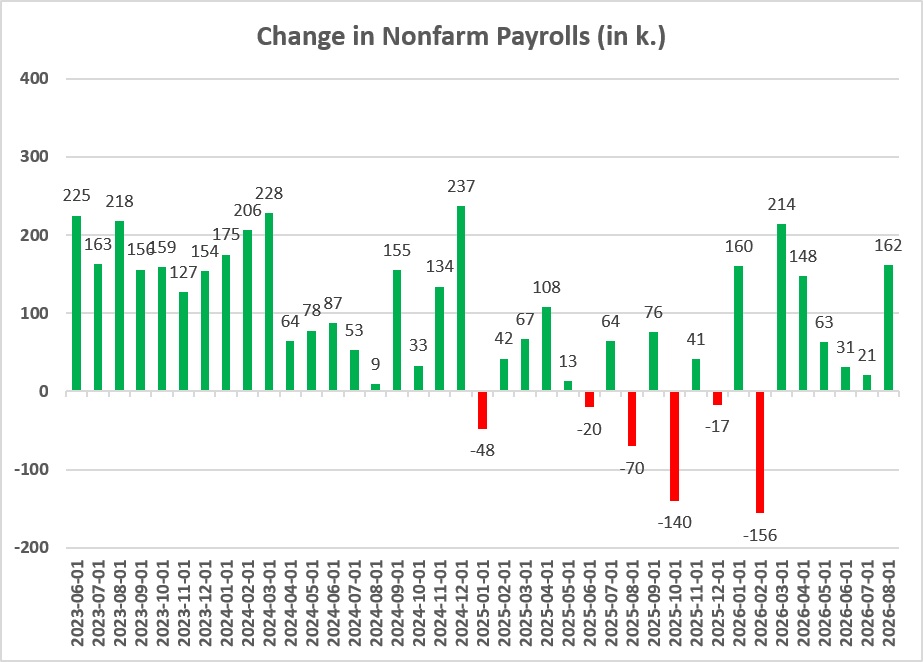
The week’s whipsaw came down to two Fed data points bookending five trading days. Early on, Governor Waller said his September rate decision would be “heavily influenced” by August CPI and signaled he’d be comfortable holding if inflation keeps trending down, comments that sparked Thursday’s rally, the best single day for stocks in nearly a month. Fed’s Williams added to the dovish tone, noting inflation continues to ease as tariff effects fade. Then Friday’s August jobs report beat expectations and kept unemployment steady, reinforcing the case for a hike rather than a pause and unwinding most of the week’s gains in a single session. By Friday, money markets were pricing over a 50% probability of a September hike.

Away from the Fed, the political temperature rose too: President Trump publicly pressured the Fed to cut rates on Friday, threatening trade actions if the central bank doesn’t comply an unusual overlay on a week already defined by policy uncertainty. The Bank of Canada held steady at 2.25% for a seventh consecutive meeting, citing trade-war uncertainty, while Swiss CPI surprised to the upside at 0.8% YoY, the highest since September 2024.
Currency markets told their own story. The yen was the standout mover, surging roughly 2% against the dollar on Thursday its biggest single-day move in over a month as traders lifted Bank of Japan hike bets and stayed alert to intervention risk, before USD/JPY settled back around 156.27 by the close. That yen volatility, layered on top of an ongoing unwind of carry-trade positioning, was one of the week’s biggest cross-asset stories alongside Brazil and crude oil.
Oil was the other major mover: WTI closed up almost 10% on the week its biggest weekly gain since July as renewed US-Iran hostilities reignited supply concerns and pushed US retail diesel to a record, adding a fresh energy-driven inflation impulse just as the market debates the Fed’s next move.

Asset & Sector Performance: Utilities and Software Take It on the Chin
Brazil, USD/JPY, and WTI were the standout movers of the week on the asset side, while broader equity benchmarks finished only modestly higher.
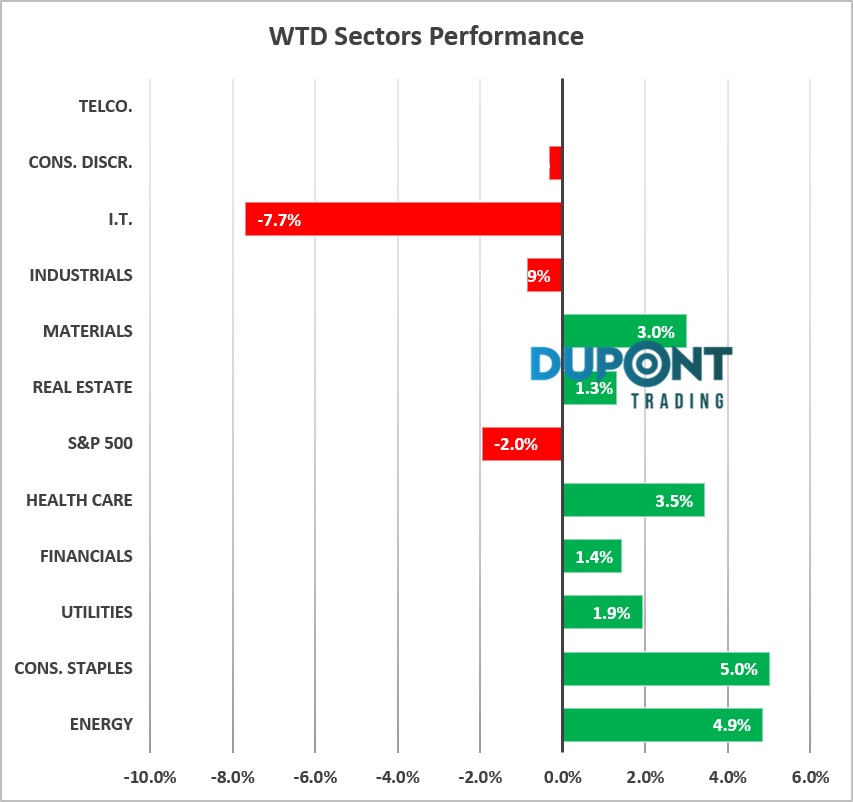
Sector-level performance stayed volatile and rotational. Energy was the lone standout on the week, adding to its commanding year-to-date lead, while Consumer Discretionary and Real Estate lagged. Within Technology, the divergence that’s defined the past few months showed up again: Semiconductors were among the week’s best-performing industries, while Software, Cyber Security, and Cloud were hit the hardest, a split that also showed up starkly in single stocks.

The winners’ list was led by SanDisk (SNDK, +17.2%), the top performer in both the S&P 500 and Nasdaq 100 on continued memory and storage momentum alongside Micron; Robinhood (HOOD, +17.1%) on strong retail trading activity and crypto-related tailwinds; Dell (+14.9%) on a solid AI-server-demand outlook; Skyworks (SWKS, +12.5%) on semiconductor sector rotation; and Deere (+10.0%) and Mosaic (+9.5%) as agricultural names rallied on firmer commodity prices.
The losers’ list was brutal by comparison. Fair Isaac (FICO, -19.2%) was the index’s worst performer. California utilities Edison International (-19.1%) and PG&E (-13.9%) sold off sharply on wildfire-liability and rate concerns. Lululemon (-16.7%) cratered after cutting FY2027 EPS and sales guidance on weakening China sales — down 18% in Friday premarket alone. Autodesk (-16.4%) and Cadence Design Systems (-14.0%) got caught in the software/EDA selloff, and Ciena (-15.2%) and Axon (-14.2%) gave back sharp prior gains.
Elsewhere, European equities underperformed as surging bond yields weighed on sentiment the Stoxx Europe 600 fell 0.8% on the week, its worst weekly drop in nearly two months, now sitting roughly 2% below its early-August record. China was a notable laggard too: despite 26% earnings growth (the fastest pace in five years), the CSI 300 slipped about 9% and the STAR 50 tumbled 29% as a weak economy and doubts about AI-driven returns weighed on sentiment.
Rates & Fed Expectations: Yields Higher, Hike Odds Above 50%
Global bonds were under pressure for much of the week, with the U.S. 10-year rising roughly 6bps to 4.78%:

The 2-year yield briefly topped 4.40%, its highest since January 2025, as markets priced in a growing probability of a September hike. The Fed is now in its blackout period ahead of the FOMC meeting in 10 days, with roughly a 60% chance of a hike currently priced.
The most dramatic move globally, though, was in UK Gilts: the 30-year yield climbed to 5.89%, a level last seen in 1998, a move reportedly cutting the Labour government’s fiscal headroom by roughly £12 billion. Norway was also reported to be considering a ~$75 billion sale of U.S. Treasuries from its sovereign wealth fund, and Apollo’s chief economist Torsten Slok flagged that U.S. yields are likely headed higher still, citing the Iran conflict and tariffs as key drivers.
Volatility & Technicals
Despite the week’s whipsaw, the VIX closed at a very compressed 14.53% both implied and realized volatility remain low by historical standards, even with the scale of the Thursday-to-Friday reversal. ES spent the last five sessions in a choppy round trip, dipping into the 7,600s before rallying sharply into Thursday and fading back on Friday’s jobs print. USD/JPY continues to trend higher on the weekly chart, though this week’s sharp Thursday spike is a reminder of how quickly carry-trade unwinds can move the pair.
Earnings Checkpoint: Broadcom’s Beat, the Street’s Shrug
The week’s most telling earnings reaction may have been Broadcom’s: the company posted its ninth consecutive earnings beat with sharply higher AI semiconductor revenue and the stock still fell, a sign that the bar for “good enough” in AI names keeps rising. Dell’s 16% surge mid-week on a solid outlook stood in sharp contrast.
Next week’s earnings calendar is lighter, headlined by Oracle, Kroger, Casey’s, Chewy, RH, and Macy’s, among others. The SPY weekly straddle is currently pricing an implied move of roughly +/- 1.1% into next Friday.

The Week Ahead: CPI and the ECB Take Center Stage
With markets closed Monday for Labor Day, the week compresses into four trading days — and two events dominate everything else:
- Thu 10-Sep: ECB Rate Decision — a 25bp hike to 2.5% is widely expected and effectively fully priced, which would reaffirm the ECB as the most hawkish G7 central bank. Focus will be on Lagarde’s press conference for signals on whether a third hike is on the table.
- Fri 11-Sep: US August CPI — the single most important data point of the week for global markets. Waller has explicitly flagged this as the decisive input for the September 17 FOMC meeting: a hot print would likely cement a hike, while a soft one could keep the door open to a hold.
Other releases: NFIB Small Business Optimism (Mon 8-Sep), China CPI/PPI/Money Supply (Tue 9-Sep), Existing Home Sales/PPI/Wholesale Inventories (Thu 10-Sep), and University of Michigan Sentiment plus the Fed’s Budget Balance (Fri 11-Sep).
On the supply side, Treasury auctions continue: $58bn in 3-year notes (Mon), $39bn in 10-year note reopening (Tue), and $22bn in 30-year bond reopening (Wed) all landing into a market already digesting the Norway Treasury-sale headlines and rising long-end yields. No Fed speakers are scheduled given the external communications blackout ahead of the meeting.
On the commodity side, watch Sunday’s OPEC+ video conference on October output quotas, along with EIA, OPEC, and IEA monthly oil market outlooks and the APPEC conference in Singapore all relevant given oil’s sharp move this week on Iran-related supply risk.
Trader’s Note: A dovish Fed comment and a hot jobs print produced two totally different markets in the same week, that’s the kind of environment where positioning discipline matters more than conviction. With CPI and the ECB both landing before Friday’s close, and money markets already leaning toward a September hike, this week’s realized moves could dwarf last week’s.
Stay Connected
Want to dive deeper or join the community?
📧 Book mentoring for Q4 2026: https://duponttrading.com/mentoring/
🎥 Access the 4×4 video series: https://duponttrading.com/4×4-course/
💬 Join the Discord: 30 channels of trading insights: https://discord.com/invite/Yf42SgAx7f
For any questions or to join our mentoring sessions, email us at Greg 📩 Contact: greg@duponttrading.com
Have a good Trading Week!
Sub Section Title Here
Lorem ipsum dolor sit amet, consectetur adipiscing elit, sed do eiusmod tempor incididunt ut labore et dolore magna aliqua. Ut enim ad minim veniam, quis nostrud exercitation ullamco laboris nisi ut aliquip ex ea commodo consequat. Duis aute irure dolor in reprehenderit in voluptate velit esse cillum dolore eu fugiat nulla pariatur. Excepteur sint occaecat cupidatat non proident, sunt in culpa qui officia deserunt mollit anim id est laborum.

THIS POST

LEARN ONLINE TRADING TODAY. THE PROFESSIONAL WAY.
Let us solve the problem and confusion around trading and finance management, the right way.
ACCESS FREE LECTURESUBSCRIBE
TO OUR BLOG
To receive opinions, market research, and data analysis in the Financial Markets
ABOUT
DUPONT TRADING
As a Professional Trader/Portfolio Manager/Hedge Fund Manager for almost 20 years, I know that learning how to Trade/Invest is a non-ending learning curve. This adventure is extremely exciting but needs to be ridden carefully.
In January 2018 after receiving many requests, I decided to start my own mentoring activities.
In October 2019, I launched the 4×4 Video Series to help Investors profitably manage their portfolios. By sharing my ideas/experiences and offering education through the 4×4 Video Series, I hope I can help you becoming a better investor.

Students
Testimonials

T. (France)
LEARN ONLINE TRADING TODAY. THE PROFESSIONAL WAY.
Let us solve the problem and confusion around trading and finance management, the right way.