
Earnings Fever: The Q3 Earnings Season Kicks Off With Record Highs, 5% Yields and Europe Under Stress
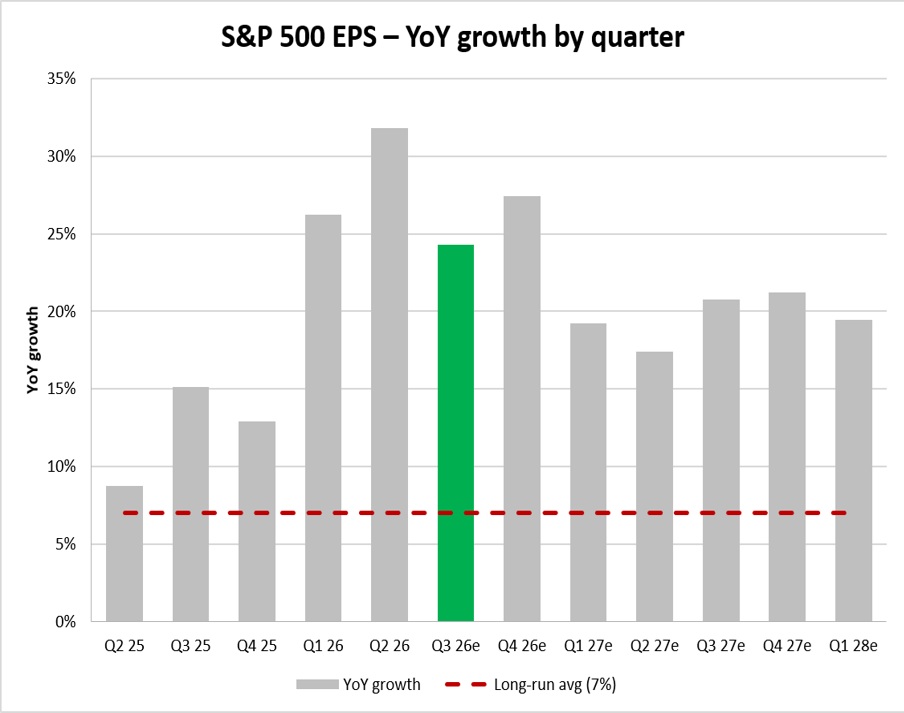
The Q3 earnings season starts on Tuesday, and expectations are sky-high. Consensus is looking for roughly 25% year-on-year EPS growth for the S&P 500 in Q3 (Bloomberg), with LSEG closer to 30%. Since companies usually beat, 30%-plus is realistic. Compare that with the S&P 500’s long-run average earnings growth of around 7% a year since 1950, and you understand why the index is holding up so well.
And it did hold up. The S&P 500 gained about 1.2% on the week and posted its first record close since August on Tuesday, even as the US 10-year yield touched 5.36% midweek. Underneath, the picture was messier: an OpenAI revenue scare hit chipmakers on Thursday, the Russell 2000 fell for a fifth straight week, and Europe became the market’s funding short once again.

Macro Catalysts: An AI Scare, Oil Spikes and a Fading Consumer
The OpenAI wobble. On Thursday, the Financial Times reported that OpenAI’s annualised revenue was tracking around $50 billion, below some market estimates. Chipmakers sold off sharply and the Nasdaq 100 had its worst day since August. By Friday, a follow-up report that OpenAI expects to reach $70 billion or more by year-end helped calm nerves. Whether the real number is $50 billion or $70 billion, the underlying question is the same: how much of the AI investment wave is turning into realised revenue? Samsung’s results the same day, solid but short of very high expectations, added to the pressure on Korean equities.
Oil remained headline-driven. Brent jumped more than 4% in a single session and briefly topped $105, before easing back towards $103 on Friday after the US Treasury said it would license Russian diesel onto global markets. Barclays notes that oil is starting to break out of its recent range, and higher rates plus rising energy prices are a toxic mix for Europe in particular.
The consumer mood keeps sliding. The University of Michigan’s preliminary October sentiment reading fell to 46.3, below September’s 48.1 and below expectations, with cost-of-living concerns the main driver. Consumer confidence has been tightly linked to inflation since 2021. That doesn’t mean US consumers have stopped spending, but they feel much worse about the economy than they did five years ago.
Elsewhere: Canada reported a surprise loss of 68,300 jobs in September. India’s central bank rolled out emergency measures to support the rupee. Corn fell as much as 4.8% after the USDA unexpectedly raised its US production estimate. In Washington, the White House scheduled a 5 November hearing on Fed Governor Lisa Cook, and Senator Elizabeth Warren pressed Treasury Secretary Bessent over his interventions in the Treasury market.
Brazil was the week’s big winner. The market cheered the first round of the presidential election, where Bolsonaro came first. The EWZ ETF jumped 12% in a single day.
Asset & Sector Performance: Not the Usual Winners
The S&P 500 rose about 1.2% and the Nasdaq Composite about 0.6%. Japan’s Nikkei added 1.1% and the FTSE 100 0.9%, while the DAX slipped 0.6%. The Russell 2000 fell 0.9%, underperforming the S&P by roughly 2 percentage points and extending its losing streak to five weeks, the longest since May 2022. Rising yields keep hurting small caps with heavily indebted balance sheets.
This week was different. Over the past three months, the S&P 500 has been broadly flat in a 2–5% range, with big winners in AI on the way up and everything else on the way down. This week flipped that pattern. Through Thursday, Goldman Sachs data shows Consumer Staples (+4.1%), Energy (+4.0%), Utilities (+3.5%) and Consumer Discretionary (+2.8%) leading. Technology lagged at +0.4%, and semiconductors were the weak spot. Industrials were the only sector down.
Friday’s telecom shock. Telecoms took a hit on Friday on news that SpaceX’s Starlink will be buying spectrum. Verizon, AT&T and T-Mobile all fell around 9% on the week, according to Goldman Sachs.
Biggest S&P 500 movers of the week:

The AI power trade was back in force, with Constellation Energy, Vistra and NRG all posting double-digit gains on data-centre electricity demand. Tower REITs rallied as a group (Crown Castle, SBA Communications, American Tower). On the downside, semiconductors took the OpenAI hit: Teradyne, Skyworks, ON Semiconductor and Lam Research all fell 8–10%. In the Nasdaq 100, ARM Holdings (-13%) was the worst performer, with CoreWeave, Nebius and Sandisk also down 8–9%. Shopify, MercadoLibre, Autodesk and Palantir all gained more than 10%. Mosaic fell on the USDA’s corn revision, which weighed on fertiliser demand expectations.
Rates & Fed Expectations: Yields Matter More Than Equities Admit
The US 10-year touched 5.36% midweek, with an intraweek peak of around 5.35–5.40%, before ending the week roughly 3bp lower at about 5.24%. The 10-year has risen about 125bp over the past year and more than 50bp since late August, with real yields doing most of the work. Both moves are roughly two standard deviations relative to the past 20 years.
“The market doesn’t care about yields” is not true. The S&P and Nasdaq are holding up because of tech. But the yield-sensitive parts of the market are clearly suffering. Real estate is down 10–12% from its July highs, and the Russell 2000 is down almost 10% from its high.
Fed pricing has calmed. The market now prices one more 25bp hike this year, most likely in December, and no move at the 28–29 October meeting in two weeks’ time. BMO argues that rising market yields are already doing the Fed’s tightening for it. Positioning also shifted, with asset managers reportedly cutting their long-duration Treasury futures positions. The big decider this week is inflation: a hot CPI or PPI would push October hike odds back up.

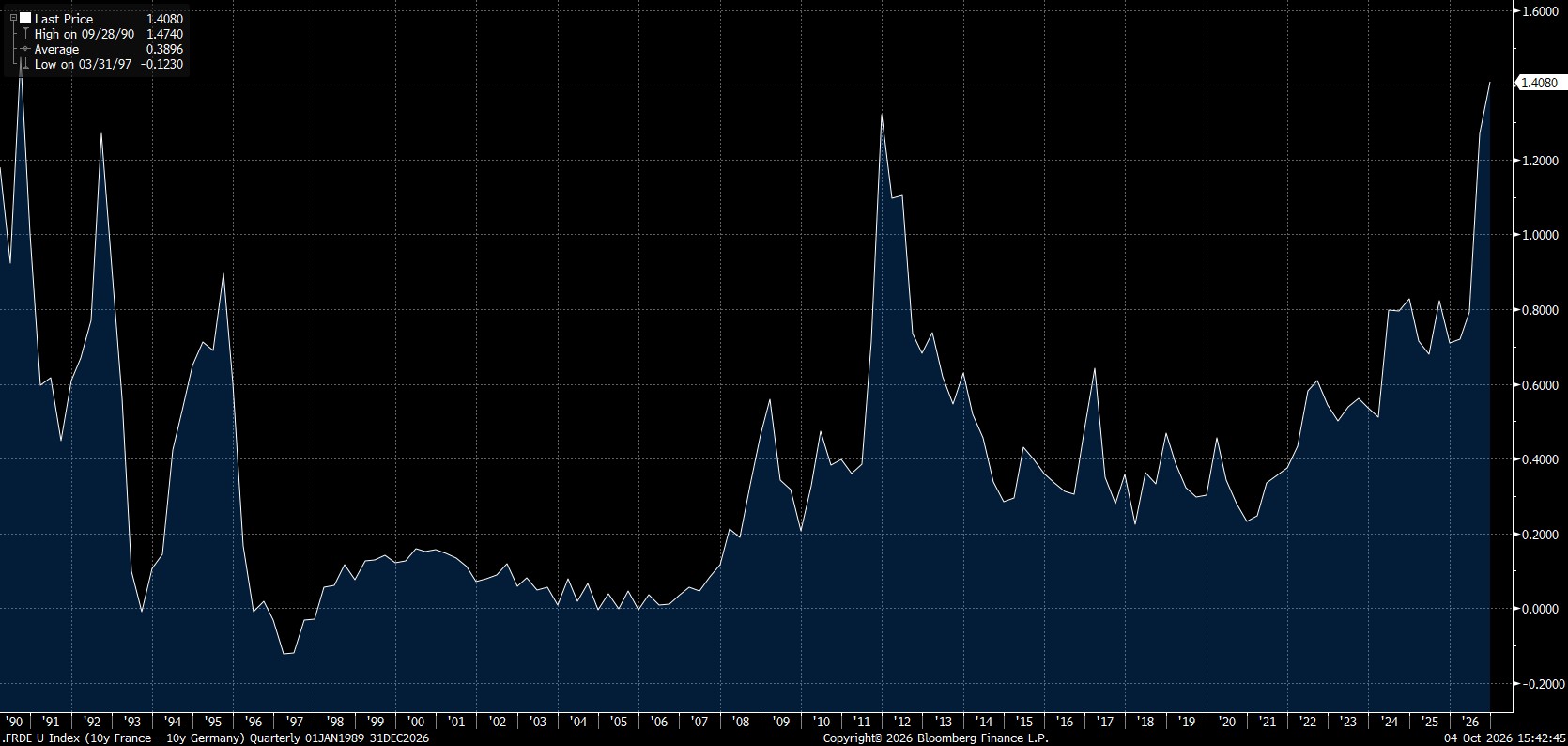
Europe: contagion fears. French OAT spreads remain near their post-eurozone-crisis highs, and Barclays notes that peripheral spreads have widened on fears of broader fiscal contagion. Barclays still sees the contagion as overdone, pointing to Spain’s improved finances and the ECB’s existing tools. Their view: this is not 2011 again. Next week, France’s budget negotiations move to the revenue side. Barclays expects the government to push the package through using Article 49.3, with a Moody’s rating review on 23 October in the background. The broader issue is structural: France’s debt-to-GDP is around 115% versus roughly 65% for Germany, and that gap has widened steadily over the past decade. With a presidential election next year, few politicians in France can take bold decisions, which makes French assets an easy target.
The financing trade. The euro has barely bounced recently. The market is buying the US and using Europe to fund it. Barclays confirms CTAs have turned net short European equities while staying long the US. European banks are feeling it: the Euro Stoxx banks index fell roughly 8% over two weeks into a technical correction, with Société Générale, Crédit Agricole and Deutsche Bank all more than 15% below their recent highs.

A contrarian signal? This week’s front cover of The Economist asked whether bonds will blow up. Magazine covers like this often mark late stages of a move. My read: the US Treasury market is likely closer to the end of its sell-off than the start, while parts of Europe remain under real pressure.

Volatility & Technicals: Flags After Flags
Volatility is compressed. The VIX is at 15 or below, and it feels like we’re heading into the midterm elections with very low volatility. The dispersion trade has been working very well against that backdrop: Goldman Sachs puts 3-month realised average stock correlation at just 0.07.
S&P 500: The pattern holds. The index consolidates, then pushes higher — flag after flag. It’s not moving quickly, but it keeps grinding to new all-time highs. The Nasdaq is following the same pattern, despite Thursday’s OpenAI candle.
Russell 2000: This is the chart to watch over the next few weeks. It is close to support, at both its trendline and its 200-day moving average, after a drawdown of almost 10% from its high. How the midterm campaigns develop could matter a lot for small caps.
Semiconductors: The sector has been consolidating for three to four months without much direction. On a logarithmic long-term chart, the uptrend is still intact.
Real estate (XLRE): Down 12% from its July highs, in a similar channel to the Russell. There is some hope this marks the end of the sell-off for the sector, and February call spreads are one way to position for a rebound with defined risk.
Breadth and positioning: Goldman Sachs’ preferred breadth measure shows the median S&P 500 stock 16% below its 52-week high, its narrowest reading since the Dot-Com Bubble. Meanwhile, AAII bullish sentiment is at its highest level since July. Flows were positive: global equity funds saw a second straight week of inflows, Technology attracted more than 40% of total equity inflows, and Financials were the only sector with outflows. Money market funds took in $166 billion, reversing the prior week’s outflows.
Earnings Checkpoint: Q3 Earnings Season Fever
Are we in an earnings bubble? Look at the numbers going into the Q3 earnings season. Over the last two quarters and the next two, S&P 500 year-on-year EPS growth is running at 15–20%-plus, far above the ~7% long-run average. The driver is AI capex, data-centre infrastructure and electricity demand.
Expectations keep rising. The Q3 S&P 500 EPS estimate has climbed to about $94, versus roughly $78 a year ago, and was recently revised up from $90, while the index has only moved modestly higher. If yields come down and oil cools (a big “if”, given Iran), that gap between earnings and prices leaves room for more upside.

The schedule:
- Tue 13-Oct: JPMorgan and the big US banks
- Wed 14-Oct: ASML
- Thu 15-Oct: TSMC
That gives the Q3 earnings season an early read on both the financials, which have been struggling, and the AI world, through ASML and TSMC.
JPMorgan is one to watch. The stock was down roughly 10% from its high two days ago, sitting at the bottom of its uptrend since 2022 and near its 200-day moving average. A break of that trend would hurt longs. Historically, JPM has often traded lower on earnings day, but expectations have come down a lot this time.

The Week Ahead: CPI, PPI, Retail Sales and the Banks
- Mon 12-Oct: Columbus Day: US Treasury cash market closed (equities open); IMF/World Bank Annual Meetings begin (through 18 Oct)
- Tue 13-Oct: NFIB Small Business Optimism; Existing Home Sales; Japan PPI (cons. 7.6%); German CPI; JPMorgan and big banks report
- Wed 14-Oct: US CPI (cons. 3.6% y/y vs 3.4%); China CPI (cons. 1.0% vs 0.8%), PPI and Trade Balance; Spain CPI; International AI Summit; ASML
- Thu 15-Oct: US PPI (cons. +0.5% m/m vs +0.4%); Retail Sales; Empire Manufacturing; Philly Fed; Jobless Claims; mid-month coupon auctions; France CPI; Japan Core Machine Orders (cons. +3.0% vs -3.7%); UK Industrial Production; TSMC
- Fri 16-Oct: Industrial Production; Eurozone and Italy CPI
Fed speakers are on the calendar throughout the week, and bond auctions remain worth following closely.
Inflation decides October. A hot CPI or PPI would revive the October hike debate. Retail sales matter more than usual: with gasoline prices up and inflation sticky, this is a read on the US consumer heading into the crucial Thanksgiving-to-Christmas season for retailers.
Europe: France’s budget talks move to the revenue side, ahead of Moody’s review on 23 October.
Trader’s Note: The S&P is at record highs on the promise of 25–30% earnings growth, while 5% yields quietly hammer everything outside of AI: small caps, real estate, and now European banks. That makes the first week of the Q3 earnings season a real test. JPMorgan needs to hold its trend, ASML and TSMC need to reassure on AI demand after the OpenAI scare, and CPI needs to behave. If all three line up, the laggards finally have room to catch up. If not, watch the Russell’s 200-day.
Stay Connected
Want to dive deeper or join the community?
🤖 New: AI webinar on 7 November. Not another “AI-everything” pitch. I’ll show you how I use AI every single day to build my own trading tools, from alerts to macro dashboards.
🗣️ New weekly community call on Discord (members only), to share ideas, ask questions and learn how to build your own trading infrastructure.
📧 Book mentoring for Q4 2026: https://duponttrading.com/mentoring/
🎥 Access the 4×4 video series: https://duponttrading.com/4×4-course/
💬 Join the Discord: 30 channels of trading insights: https://discord.com/invite/Yf42SgAx7f
For any questions or to join our mentoring sessions, email us at Greg 📩 Contact: greg@duponttrading.com
Have a good Trading Week!
Sub Section Title Here
Lorem ipsum dolor sit amet, consectetur adipiscing elit, sed do eiusmod tempor incididunt ut labore et dolore magna aliqua. Ut enim ad minim veniam, quis nostrud exercitation ullamco laboris nisi ut aliquip ex ea commodo consequat. Duis aute irure dolor in reprehenderit in voluptate velit esse cillum dolore eu fugiat nulla pariatur. Excepteur sint occaecat cupidatat non proident, sunt in culpa qui officia deserunt mollit anim id est laborum.
Related Articles
France Blows Out, Payrolls Flop, 30-Year Hits 5.63%: Only Tech Holds the Line
Another week of big moves for bonds, and a French bond spread crisis…
VIEW POST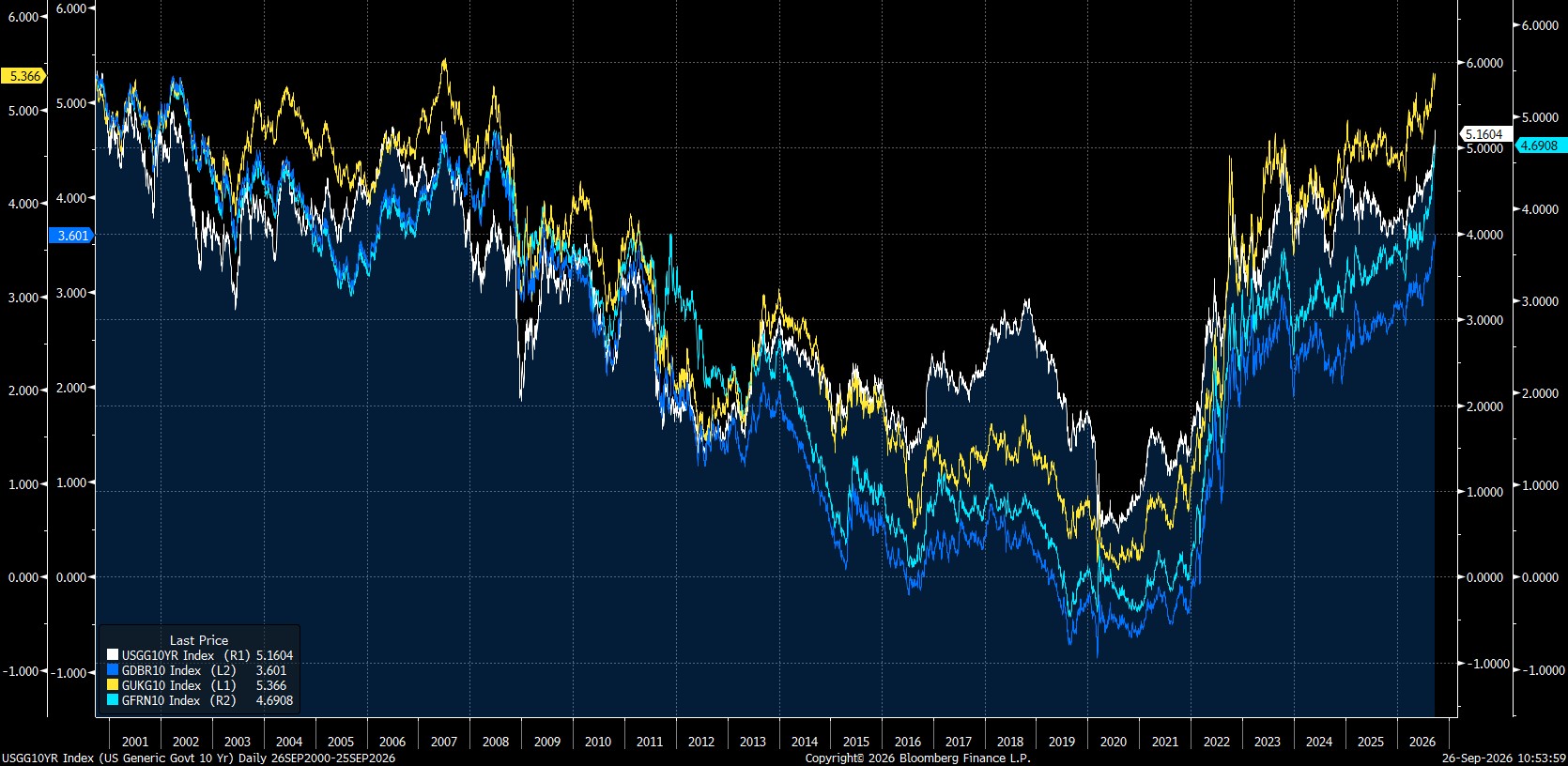
Stocks Shrug Off 5.2% Yields but Breadth Just Hit Dot-Com Lows
Everyone is a bond trader these days. The US 10-year added roughly 17bp…
VIEW POSTTHIS POST

LEARN ONLINE TRADING TODAY. THE PROFESSIONAL WAY.
Let us solve the problem and confusion around trading and finance management, the right way.
ACCESS FREE LECTURESUBSCRIBE
TO OUR BLOG
To receive opinions, market research, and data analysis in the Financial Markets
ABOUT
DUPONT TRADING
As a Professional Trader/Portfolio Manager/Hedge Fund Manager for almost 20 years, I know that learning how to Trade/Invest is a non-ending learning curve. This adventure is extremely exciting but needs to be ridden carefully.
In January 2018 after receiving many requests, I decided to start my own mentoring activities.
In October 2019, I launched the 4×4 Video Series to help Investors profitably manage their portfolios. By sharing my ideas/experiences and offering education through the 4×4 Video Series, I hope I can help you becoming a better investor.

Students
Testimonials

T. (France)
LEARN ONLINE TRADING TODAY. THE PROFESSIONAL WAY.
Let us solve the problem and confusion around trading and finance management, the right way.
Reader Interactions