
Stocks Shrug Off 5.2% Yields but Breadth Just Hit Dot-Com Lows
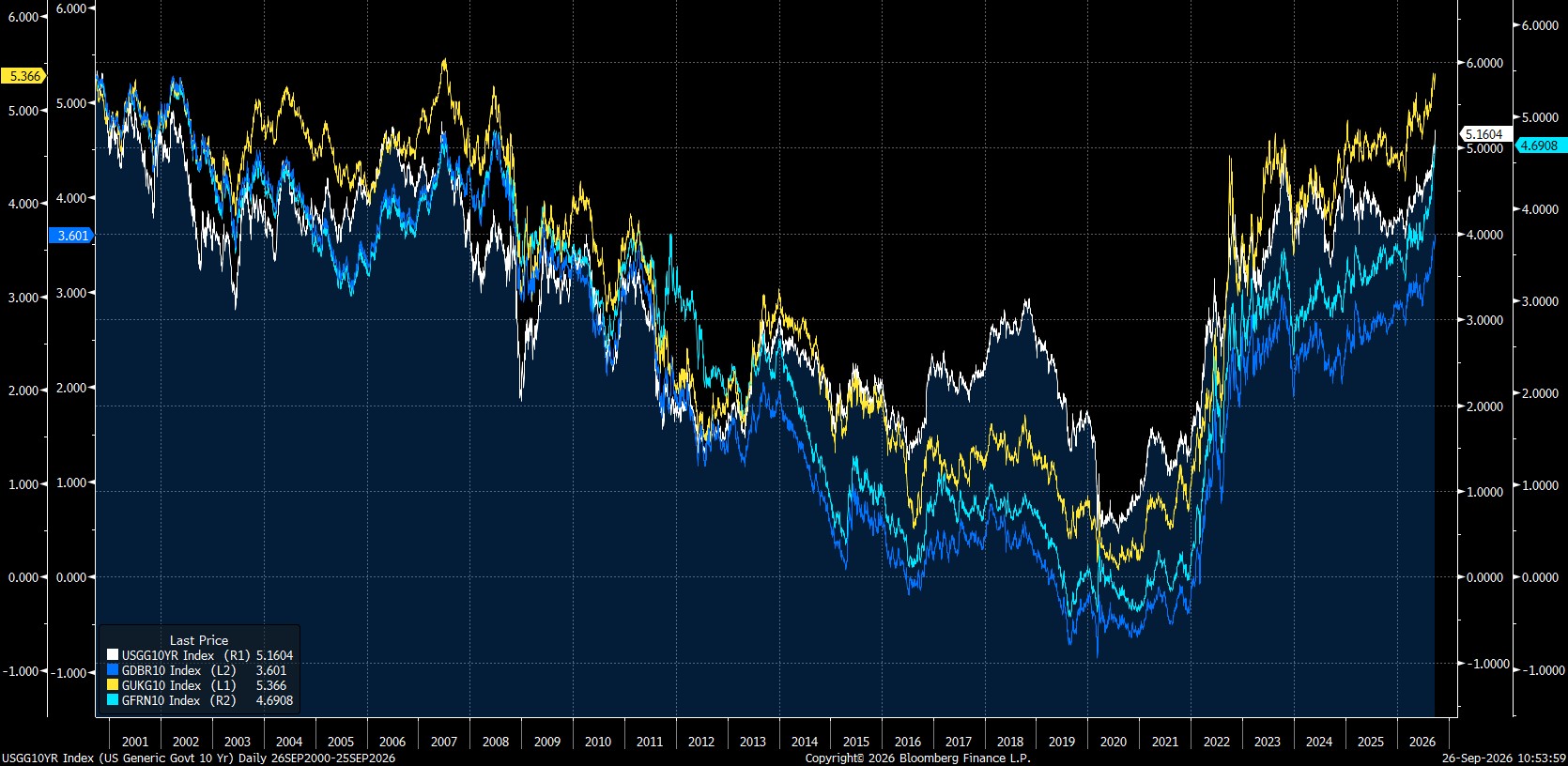
Everyone is a bond trader these days. The US 10-year added roughly 17bp on the week to around 5.2%, a 5-year auction flopped, and bond volatility jumped to its highest level since the US-Iran tensions in March. And yet the S&P 500 finished the week higher, sitting only about 1% below its mid-August record, with the VIX barely moving from 15.
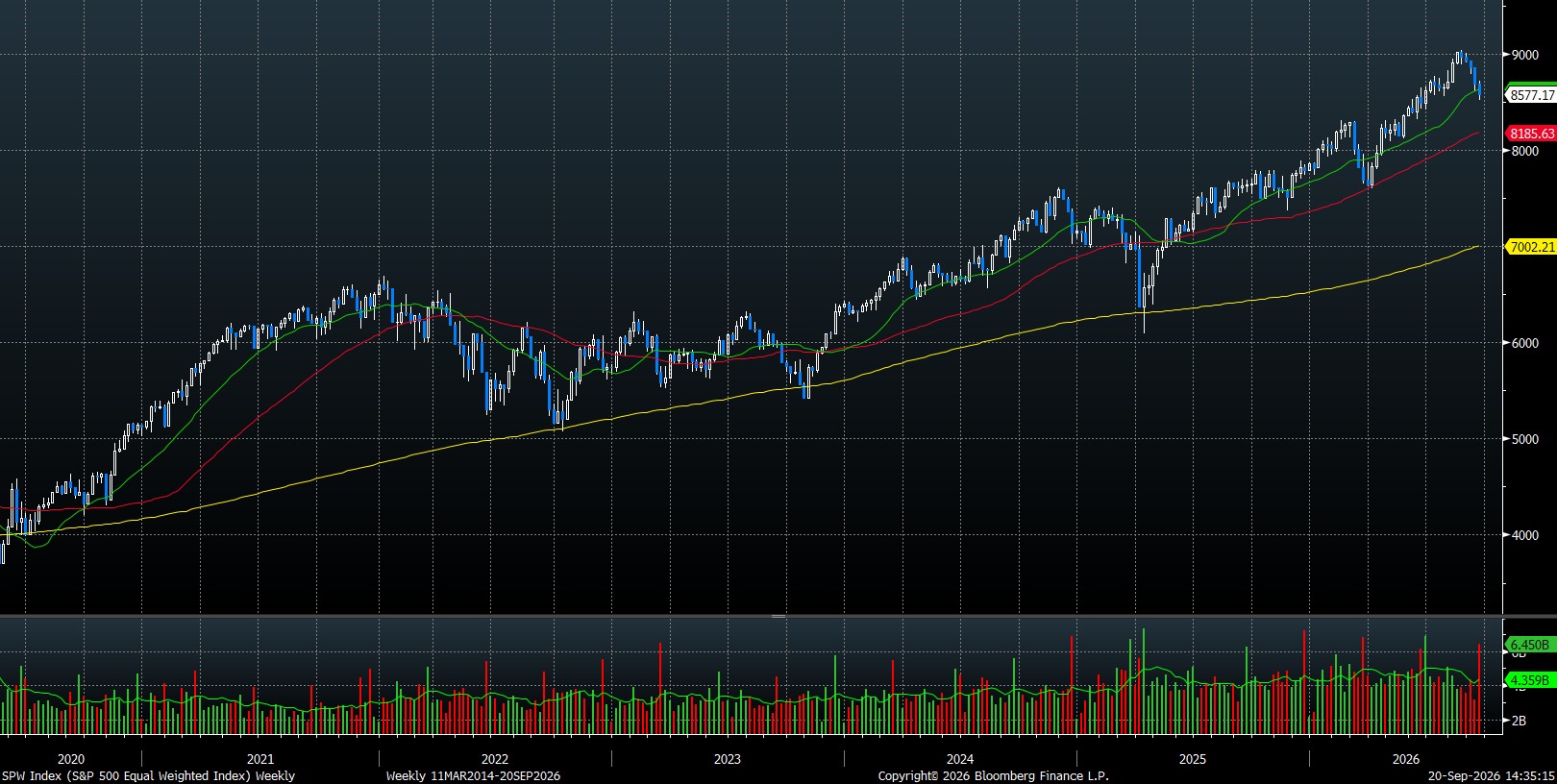
Look underneath, though, and the picture is far less comfortable. The median S&P 500 stock is 16% below its 52-week high, market breadth has narrowed to its worst level since the Dot-Com Bubble, and global equity funds just posted their first weekly outflow in twelve weeks. This is a market being carried by big tech and AI earnings while everything rate-sensitive quietly bleeds.
Macro Catalysts: A Hot Economy, a Failed Auction, and Headline-Driven Oil
The economy is running hot. Wednesday’s US flash manufacturing PMI came in at 57.0, with Bloomberg describing overall business activity as expanding at its fastest pace since 2021. If you follow the 4×4 framework, you know how closely ISM-style readings track US GDP: a print in the high 50s is consistent with an economy growing at roughly 4–5%, far above what anyone expected three months ago. The Atlanta Fed’s GDPNow model backs this up at 5.02% for Q3, versus a Bloomberg consensus of 2.78% (the New York Fed nowcast is more conservative at 2.33%).
The 5-year auction didn’t go well. Wednesday’s 1pm New York auction met a very weak bid, bonds sold off hard, and stocks didn’t like it. That was the low point of the week for equities. Liquidity didn’t help either: Japanese markets were closed Monday through Wednesday, removing a chunk of the usual Asian demand for Treasuries.
Oil stayed headline-driven. Brent pushed above $100 midweek on Middle East tensions before late-week reports that Iran had proposed a plan to end the conflict and reopen the Strait of Hormuz. But the headlines flip daily, the latest reports had Trump rejecting an arrangement to reopen the Strait for the next seven days. WTI ended the week down roughly 7–8%, trading in the $85–90 area. A constructive US-China meeting also helped equities bounce from Thursday onward.
Europe took the worst of it. Barclays describes a double hit this week from higher energy prices and renewed US tech leadership. Euro-area inflation is expected to have risen to 3.6% in September, the highest in three years, and markets are now pricing roughly four additional 25bp ECB hikes over the next 12 months. Barclays still sees European growth as more resilient than performance implies, citing improving PMIs, the IFO survey, AI-related capex, and German fiscal spending.
Asset & Sector Performance: Big Tech Up, Everything Else Struggles
The S&P 500 gained around 1.2% on the week with the Nasdaq outperforming, while the Russell 2000 continued to lag. Small and mid-caps simply don’t like rising yields, and the Russell’s year-to-date lead over the S&P 500 has shrunk from 11 percentage points in June to just 2 points.

Elsewhere, Japan’s Nikkei was the standout among major indices (+1.3%), while the FTSE 100 (-0.4%) and DAX (-0.7%) slipped. The US dollar rose about 1%, crypto extended its September rally, the yen weakened despite Japanese officials once again calling it undervalued, and gold fell nearly 2% on higher real yields.
Sector playbook, six weeks running: Technology and semiconductors lead, anything yield-sensitive with a heavy balance sheet lags (utilities and real estate), and health care has provided some defensive outperformance. Banks are worth watching closely with names like Goldman Sachs and JPMorgan have been underperforming ahead of the Q3 earnings season, which the banks kick off.
Biggest S&P 500 movers of the week:

Semiconductors and chip-design software dominated the upside, with Intel, AMD, Monolithic Power, and Synopsys also posting strong weeks, and Cadence and Datadog topping both the S&P 500 and Nasdaq 100 leaderboards. On the downside, payroll and fintech (Paychex, Intuit) and software names like Adobe and AppLovin came under pressure.
The standout single-name story remains Meta, up roughly 30% over the past month and massively outperforming Apple, Alphabet, and NVIDIA on the strength of its new AI agents. It’s a reminder that there is still real alpha inside tech, you have the pack of stocks that trade together through the ETFs, and then you have names like Meta being driven by their own catalyst.

The breadth problem. Goldman Sachs notes that the 10 largest companies now account for about 40% of S&P 500 market cap, and that average realized stock correlation has fallen to just 0.06. The earnings story is just as concentrated: most of next year’s expected earnings growth comes from one sector, driven by AI capex, memory, and data-center infrastructure.
Rates & Fed Expectations: Not Panic Mode, Yet
The US 10-year underperformed other developed markets this week, rising around 17bp. Zoom out and most developed-market 10-year yields have moved almost a full percentage point over the past nine months, while Japan’s 10-year now sits around 3.08% after a massive 12-month move. China’s 10-year is the outlier, trending lower to around 1.67%.
Big move? Yes. Panic? Not yet. US yields are back to 2005–2006 levels in a world where developed-market inflation is running around 3%. Panic mode would mean talk of the Fed stepping in to protect market plumbing and we’re not there.
What is concerning is the speed. The real 10-year yield has risen 53bp in a month, crossing the two-standard-deviation “speed limit” that has historically been associated with negative equity returns. Short-dated Treasuries also underperformed, with 2-year yields reaching their highest level since 2024.
Fed pricing keeps shifting hawkish. Following last week’s first hike since 2023, the market is pricing roughly a 65–70% chance of another hike at the October meeting, and at least one more before year-end is effectively locked in. Out to the end of next year, markets now price around three and a half hikes, about one more than a month ago, largely because strong early-September payrolls forced a growth repricing. Fed Governor Barr added fuel, saying further tightening is likely needed to bring inflation back to target.
What this means for equities: The S&P 500 forward P/E has compressed from 23x a year ago to 19x, now in line with its 10-year average, even as the index is up double digits year to date, because earnings have grown far faster than prices. Bonds have cheapened too, leaving equity risk premiums near multi-decade lows and making the “there is no alternative” argument for equities look much weaker. With the 10-year offering 5.2%, there is now a genuine alternative.
Volatility & Technicals: Calm Equities, Stressed Bonds
The disconnect is striking: the MOVE Index (bond volatility) has spiked to its highest level since March, while the VIX sits around 15 with no sign of broader market stress. The S&P 500 weekly straddle is pricing roughly ±1.3% for next week, essentially the same message as a 15 VIX.
Technicals: The S&P 500 remains in a strong uptrend, moving in steps, consolidate, then push higher. The Magnificent 7 broke out on Monday as flagged last weekend, confirming that Meta and the other mega-caps are carrying the index. The Russell 2000 has been underperforming since mid-August and the chart still looks weak.
Positioning and flows: Global equity funds saw $10bn of outflows, ending an eleven-week inflow streak, driven by $21bn of US equity redemptions. Technology and Financials saw the heaviest sector outflows, while US Treasuries extended their unbroken run of inflows dating back to April.
Quarter-end rebalancing is a wildcard. Quarter-end lands on Wednesday. With the S&P 500 up roughly 3% over the quarter while bonds have been hammered (yields up around 70bp), a classic 60/40 portfolio would normally rebalance out of equities and into bonds. But bond convexity could push flows the other way. The direction isn’t clear, but the setup argues for some big moves over the next three sessions.
Earnings Checkpoint: Micron Takes Center Stage
Micron (MU) reports Wednesday after the close and is the name to watch. Now a roughly $1.2 trillion company, it’s a direct read on AI memory demand. The options market is pricing a move of about 6.7%, versus an average move of roughly 8% over its last eight reports.

Nike (NKE) also reports, alongside a handful of Asian names including Nidec, Shimamura, and New World Development.
The Week Ahead: PCE, Payrolls, ISM, and Quarter-End
A data-heavy week, which Barclays expects to bring further volatility:
- Mon 28-Sep: Taiwan markets closed; UN General Assembly debate concludes; Fed speakers every day this week
- Tue 29-Sep: Conference Board Consumer Confidence; UK Mortgage Approvals
- Wed 30-Sep: PCE Price Index and Personal Spending; GDP; Chicago PMI; China Manufacturing PMI (cons. 50.1 vs 49.8); UK GDP; quarter-end; Micron earnings
- Thu 1-Oct: ISM Manufacturing (cons. 55 vs 54.6); global Manufacturing PMIs; Japan Tankan survey; China Golden Week begins (mainland and Hong Kong markets closed)
- Fri 2-Oct: Nonfarm Payrolls and Unemployment Rate; Eurozone CPI; Tokyo CPI (cons. 2.3% vs 1.9%); Factory Orders
Also on the radar: the RBA rate decision, BOJ meeting minutes, the UK Labour Party Conference, and as always the Iran headlines.
PCE: Inflation is running around 3.2–3.3% year on year, well above the Fed’s mandate. The key is the trajectory — are we heading toward 3.5–4%? Any renewed oil spike from Iran headlines would push in that direction.
Payrolls: The last print was very strong at 162,000, with consensus now around 90,000–104,000, versus an average of roughly 30,000 over the prior three months. Is the labour market re-accelerating? Two caveats: payrolls are a lagging indicator, and six months ago the dominant narrative was that AI would destroy jobs, a strong print would challenge that story.
China: Chinese PMIs have been weak, below 50, and the Golden Week holiday from Thursday means thinner liquidity across Asia.
Trader’s Note: When the 10-year hits 5.2%, a Treasury auction fails, and bond vol jumps to a six-month high, and the S&P 500 still closes the week higher, that’s resilience, but it’s resilience built on a very narrow foundation. With breadth at its worst since the Dot-Com era, PCE and payrolls deciding the October hike, and quarter-end rebalancing landing in the middle of it all, this is a week to respect the trend in big tech while keeping position sizes honest.
Stay Connected
Want to dive deeper or join the community?
🎙️ Free webinar — How to Trade the Midterm Elections: Saturday 3 October, 1:00pm London / 8:00am New York. Register here: https://us02web.zoom.us/meeting/register/ejQuWdYCQ4SQFcP_mvl8yg
📧 Book mentoring for Q4 2026: https://duponttrading.com/mentoring/
🎥 Access the 4×4 video series: https://duponttrading.com/4×4-course/
💬 Join the Discord: 30 channels of trading insights: https://discord.com/invite/Yf42SgAx7f
For any questions or to join our mentoring sessions, email us at Greg 📩 Contact: greg@duponttrading.com
Have a good Trading Week!
Sub Section Title Here
Lorem ipsum dolor sit amet, consectetur adipiscing elit, sed do eiusmod tempor incididunt ut labore et dolore magna aliqua. Ut enim ad minim veniam, quis nostrud exercitation ullamco laboris nisi ut aliquip ex ea commodo consequat. Duis aute irure dolor in reprehenderit in voluptate velit esse cillum dolore eu fugiat nulla pariatur. Excepteur sint occaecat cupidatat non proident, sunt in culpa qui officia deserunt mollit anim id est laborum.

THIS POST

LEARN ONLINE TRADING TODAY. THE PROFESSIONAL WAY.
Let us solve the problem and confusion around trading and finance management, the right way.
ACCESS FREE LECTURESUBSCRIBE
TO OUR BLOG
To receive opinions, market research, and data analysis in the Financial Markets
ABOUT
DUPONT TRADING
As a Professional Trader/Portfolio Manager/Hedge Fund Manager for almost 20 years, I know that learning how to Trade/Invest is a non-ending learning curve. This adventure is extremely exciting but needs to be ridden carefully.
In January 2018 after receiving many requests, I decided to start my own mentoring activities.
In October 2019, I launched the 4×4 Video Series to help Investors profitably manage their portfolios. By sharing my ideas/experiences and offering education through the 4×4 Video Series, I hope I can help you becoming a better investor.

Students
Testimonials

K. (United Kingdom)
LEARN ONLINE TRADING TODAY. THE PROFESSIONAL WAY.
Let us solve the problem and confusion around trading and finance management, the right way.