
Nvidia Drama: A CEO Exit, Yields Back Above 5% and Nvidia Earnings Ahead
Weekly Market Recap — Week ending 13 November 2026
This week was all about the Nvidia drama and the return of higher yields. Nvidia’s CEO, the visionary who led the company for more than two decades from gaming into AI, is out. The stock lost about 13% on the week, roughly $600 billion of market value, and fell below $4 trillion. At the same time, a hot October CPI pushed the US 10-year back above 5%.
And yet the S&P 500 rose about 2% and is back above its pre-election close. As Goldman Sachs put it, the move is “really quite remarkable,” and an encouraging answer to the question of whether the market can still go up when its biggest stocks break down. Now everything points to Tuesday night: Nvidia earnings.
Macro Catalysts: The Nvidia Drama, Hot CPI and a Hawkish Fed
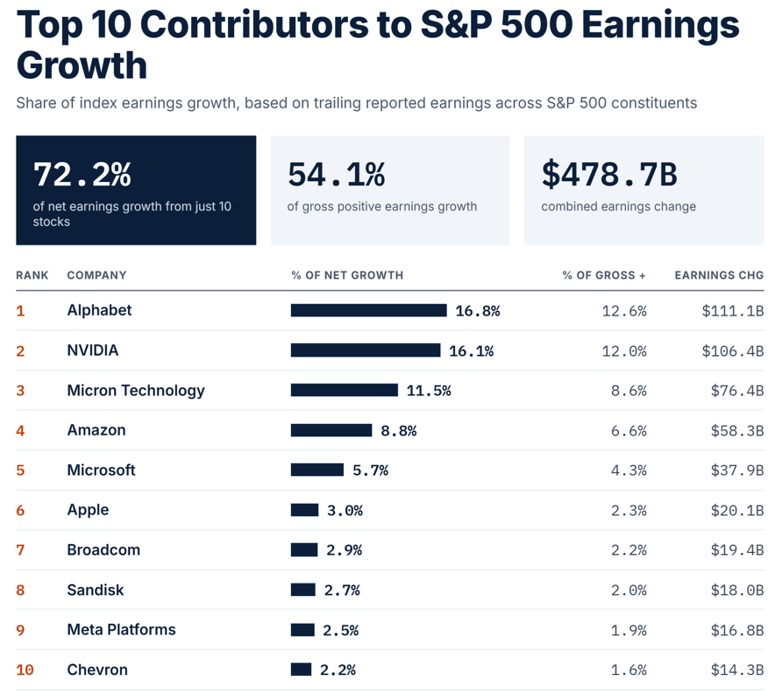
1. The Nvidia drama. Why does it matter so much? Look at the S&P 500’s earnings growth: Nvidia alone accounts for about 16% of it, the largest contribution of any company. And it’s not only Nvidia. There’s a whole ecosystem built around it: AI infrastructure names that depend on Nvidia-linked financing, and, in Europe, companies like Nokia, where Nvidia took a stake. So the leadership change puts a question mark over the next leg of the AI capex cycle.

There’s a second, less obvious point. Every time AI capex worries flared up, Nvidia’s leader could calm the sector with one interview or one keynote. That voice is gone. Without someone able to steer the whole industry’s narrative, expect more volatility in AI, on top of the reversal in momentum we’ve seen over the past couple of months.
What’s encouraging is how the market reacted. Money didn’t leave semis; it rotated within them. Goldman notes the SOX semiconductor index rose almost 7% in a week when Nvidia lost around 14%, with buyers moving into AMD, Broadcom, Applied Materials and the memory names.
2. Hot CPI, again. Tuesday’s October CPI showed core inflation up 0.3% for a third straight month and headline up 0.4%, with price pressures broadening across everyday goods and services. Friday’s PPI was more benign, but it didn’t change the picture: inflation is sticky. Goldman added a third Fed hike, in March, to its forecast and warned that the slow pass-through of past energy prices could keep pushing inflation up until June next year.
3. The Fed turns more hawkish. Fed speakers were uniformly hawkish:
- Governor Waller backed a 25bp December hike and said he was open to 50bp.
- Dallas Fed’s Logan effectively supported him.
- Vice Chair Jefferson said the inflation trajectory is now the key signal.
- SF Fed’s Daly said further tightening will likely be needed.
- Boston Fed’s Collins called for a “steady, gradual” path of hikes.
Chair Warsh also announced a structural change: the October 2027 meeting will be devoted to strategy with no rate vote, cutting voting meetings to seven a year.
4. Strong growth, not a slowdown. Barclays makes the key macro point: the US economy is “firing on all cylinders.” Both the jobs report and CPI surprised strongly to the upside, and the US economic surprise index is at new highs. The growth scare behind the recent pullback hasn’t materialised. We’re back to the familiar playbook of strong growth, sticky inflation and rising rates.
Asset & Sector Performance: Stocks Bounce, Crypto and Gold Sold
US stocks bounced about 2% for both the S&P 500 and the Nasdaq after last week’s de-grossing selloff. Japan was the standout, with the Nikkei up 4–6%. The Stoxx 600 rose 2.4%, its best week since July, the DAX added 1.8% and the FTSE 100 1.3%.
There’s a catch on Europe, though. The Stoxx 600 has been making new highs, but the euro is down about 3% over the past two to three months while the index is up about 3%. In dollar terms, Europe is roughly flat. When people say an index is making new highs, always adjust for FX.

Crypto was the biggest loser. Bitcoin fell more than 13% on the week and kept falling over the weekend before bouncing around $62,000. There are two reasons:
- The multi-billion-dollar exchange hack a few weeks ago is not a good sign for a sector that has spent years saying it’s better than fiat money. We’ve seen redemptions.
- Year-end liquidity. In November, many investors look for liquidity heading into year-end, as liquidity dries up unless central banks add more.
The same liquidity effect hit gold and silver (gold -4.6%) and commodities more broadly.
The dollar was very strong on higher yields. The euro is where I’m watching positioning: we’re starting to see extreme short positions, partly because Goldman and others highlight European election risks for 2027. I think the pessimism on the euro as a currency (not on European stocks) is getting a bit extreme, so I’m starting to build a euro long versus the dollar.
Industries and sectors: The S&P’s industry chart tilted to the right this week. The losers were timber, social media, solar, gold miners, silver and gold. Every sector was green. Energy was the biggest winner, bouncing after last week’s post-midterm selloff, as recent headlines suggest the Iran conflict may not be over. Tech outperformed the index, but by less than its beta would suggest. The market is struggling to find its new leaders: momentum has underperformed for two months, and AI and semis aren’t the easy trade they used to be. The positive side: market breadth is much better. More stocks, including defensives, are back above their 50- and 200-day moving averages, though not in Tech. Bloomberg notes S&P 500 defensives are trading near their highest valuations in at least a decade.

Biggest S&P 500 movers of the week (Friday to Friday):

The table shows the rotation within semis. AMD, Broadcom, Monolithic Power, Arista, Ciena (+15%), Seagate (+15%), Teradyne (+14%), Coherent (+13%) and Micron (+13%) all surged while Nvidia fell. Homebuilders (NVR, Lennar -6%) sold off as 10-year yields pushed back above 5%. First Solar was the worst performer as higher rates weighed on clean energy. In the Nasdaq 100, Astera Labs (+16%), Rocket Lab (+16%), CoreWeave (+15%) and Lam Research (+13%) gained, while Strategy (-13%) tracked Bitcoin lower.
Rates & Fed Expectations: Back Above 5%
This week was about yields going higher:

We’re not back at the 5.35% peak, but the market is saying the Fed won’t be as accommodative as it thought not long ago. The front end took the brunt.
Fed expectations have moved up across the curve. Compared with the start of the month, pricing is higher for every meeting. A December hike is now fully priced, with markets pricing more than 25bp for that meeting. Pricing for January is up about 11bp, with the debate now about back-to-back hikes. The same shift runs through almost all of 2027. Bloomberg Intelligence notes that sticky inflation, resilient growth and a potentially restrictive Fed could keep Treasury yields elevated well into 2027.
Elsewhere, BoE MPC member Megan Greene said it was appropriate to tighten proactively given the risk of wage growth becoming entrenched.
Volatility & Technicals: A Higher Floor for the VIX
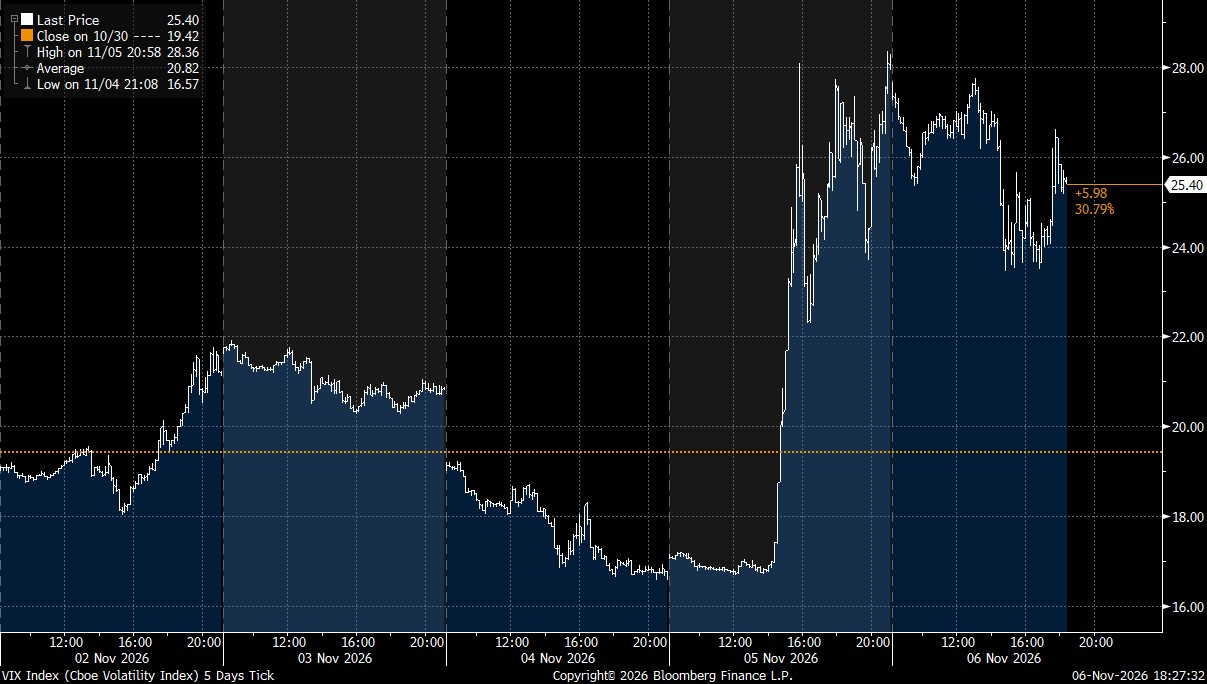
VIX: Heading into Nvidia earnings, it’s around 19, down from the highs of recent weeks. But there are good signs that the VIX floor is now higher than before, because of AI uncertainty, hedge fund de-grossing and the war in Iran. Each time the VIX drops to 17–18, I wouldn’t expect it to go much lower. For traders, that means higher volatility and bigger moves, so you should probably reduce position sizes. This is a different market regime from the one we had not long ago.
Positioning has cleaned up. Barclays notes that risk-control funds have cut equity exposure from 96% to 45%, a 12-month low, and crowding in European cyclicals is at an 18-month low. Their view is that cyclicals and tech are “no longer priced for perfection,” and the tactical risk-reward is tilted in favour of cyclicals. Flows confirm the dip-buying: global equity funds have taken in money for seven straight weeks, about $400 billion in total, including nearly $100 billion this week, the most since June. Tech took more than 40%.
S&P 500: It has struggled for three to four months without much direction. Volume picked up on the unwind, with big candles. We’re still above the 200-day moving average, which is roughly where we bounced, but below the 50-day. On Monday we squeezed quickly up to 7,600. Friday’s selloff was about half the size of the post-midterm drop. The S&P is now only 4–5% from its all-time high, despite sticky inflation, an Nvidia ecosystem at risk, a blue-wave Congress and oil still elevated. The market has digested a lot.
Nasdaq futures: These have bigger moves because of their beta. They’re close to their trend line, after what looked like a purge on big volume. That’s not a bad signal, but it’s not an easy level to trade from.
Nvidia: Ahead of Nvidia earnings, the chart matters. After the CEO news on Wednesday evening, the stock went straight to its first big support at $150, on huge volume on Thursday, then bounced about 10%. If $150 doesn’t hold, the next big level is $100, another 30% lower.
JPMorgan: For me, this is the real read on the economy. As long as JPMorgan holds its uptrend, it’s not the end of the world. So far, it’s holding.
Bitcoin: This is the de-grossing and year-end liquidity at work. After two or three bad sessions, it’s back near July levels around $70,000. Weekend moves aren’t always a good guide to the week.
Earnings Checkpoint: Nvidia Earnings Are the Main Event
Nvidia earnings land on Tuesday after the close. The options market is pricing a move of about 7.8%, versus an average realised move of about 4% over the last 12 reports. In other words, the market is pricing roughly twice the historical move. You normally pay a bit more for implied volatility than realised, but not to that extreme. Barclays’ take: “a lot is at stake, but much negativity looks priced in.” Any meaningful deterioration in fundamentals could reverberate across the AI supply chain and the broader cyclical complex.

Is it peak earnings? Goldman forecasts S&P 500 EPS growth slowing from 36% this year to 11% in 2027, but it hasn’t slowed yet: Q3 growth is on pace to beat even Q2’s very strong pace. S&P 500 earnings are now a record share of GDP. Valuations have already compressed by 3–4 turns, and Goldman still sees a path to $1.4 trillion of AI capex in 2027.
Retail earnings season starts: Walmart, Target, Home Depot, Lowe’s, TJX and Ross Stores. These matter more than usual. We’re heading into Thanksgiving, Black Friday and Cyber Monday, and mid-November to mid-January is the most important period of the year for retailers. The US consumer has held up remarkably well against inflation and higher rates. Housing has struggled because of rates, but pure consumption, like retail sales, has held. We know it’s a K-shaped economy, with lower-income households struggling. Part of why names like Walmart and Costco have rallied over the past two to three months is that markets expect the new Democratic Congress to reverse cuts to support for lower-income Americans, such as SNAP.
The Week Ahead: Nvidia, Retail Sales and the FOMC Minutes
- Mon 16-Nov: Empire Manufacturing (cons. 17.0 vs 25.5); Japan Q3 GDP and Industrial Production; UK Rightmove House Prices
- Tue 17-Nov: Retail Sales; Industrial Production (cons. +0.1% vs +0.7%); NAHB Housing Index; Eurozone ZEW; UK Unemployment; Nvidia earnings after the close
- Wed 18-Nov: Housing Starts (cons. 1,250k vs 1,221k) and Building Permits; UK CPI (cons. 3.5% vs 3.5%); Eurozone CPI; Japan Trade Balance
- Thu 19-Nov: FOMC Minutes; Philly Fed; Jobless Claims (cons. 198k vs 200k); Leading Index; China Retail Sales and Industrial Production
- Fri 20-Nov: University of Michigan Sentiment; Japan CPI (cons. 2.5% vs 2.1%); UK Retail Sales and GfK Consumer Confidence; Eurozone Consumer Confidence
Also on the radar:
- A US–Russia–China meeting on Thursday that will make headlines, though I’m not sure much will come out of it
- A lot of Fed speakers
- Bond supply, as always
- Any news on Nvidia’s succession and strategic direction
- Iran and oil
The SPY weekly straddle is pricing about ±1.8%, much like last week.
Trader’s Note: The market lost one of the most important voices in AI, took a 28bp jump in the 10-year and a hot CPI, and still finished the week up about 2%. That’s resilience, and it’s the rotation inside semis that tells you AI money is being reallocated, not abandoned. But this is a new regime: a higher VIX floor, sticky inflation and a Fed debating back-to-back hikes. Reduce sizes, respect $150 on Nvidia going into Tuesday’s earnings, and watch JPMorgan’s trend as your read on the real economy.
Stay Connected
Want to dive deeper or join the community?
🎓 Free webinar: How a prop trader builds his watchlist. Friday 5 December, 1:00pm London / 8:00am New York. Register here: https://us02web.zoom.us/meeting/register/JrQ_oYC-TJOHnv82TrdbHA#/registration
📧 Mentoring starting January 2027: I’m getting close to full capacity, so book soon: https://duponttrading.com/mentoring/
🎥 Access the 4×4 video series: https://duponttrading.com/4×4-course/
💬 Join the Discord: a free channel plus ~20 paid channels of trading insights: https://discord.com/invite/Yf42SgAx7f
For any questions or to join our mentoring sessions, email us at Greg 📩 Contact: greg@duponttrading.com
Have a good Trading Week!
Sub Section Title Here
Lorem ipsum dolor sit amet, consectetur adipiscing elit, sed do eiusmod tempor incididunt ut labore et dolore magna aliqua. Ut enim ad minim veniam, quis nostrud exercitation ullamco laboris nisi ut aliquip ex ea commodo consequat. Duis aute irure dolor in reprehenderit in voluptate velit esse cillum dolore eu fugiat nulla pariatur. Excepteur sint occaecat cupidatat non proident, sunt in culpa qui officia deserunt mollit anim id est laborum.
THIS POST

LEARN ONLINE TRADING TODAY. THE PROFESSIONAL WAY.
Let us solve the problem and confusion around trading and finance management, the right way.
ACCESS FREE LECTURESUBSCRIBE
TO OUR BLOG
To receive opinions, market research, and data analysis in the Financial Markets
ABOUT
DUPONT TRADING
As a Professional Trader/Portfolio Manager/Hedge Fund Manager for almost 20 years, I know that learning how to Trade/Invest is a non-ending learning curve. This adventure is extremely exciting but needs to be ridden carefully.
In January 2018 after receiving many requests, I decided to start my own mentoring activities.
In October 2019, I launched the 4×4 Video Series to help Investors profitably manage their portfolios. By sharing my ideas/experiences and offering education through the 4×4 Video Series, I hope I can help you becoming a better investor.

Students
Testimonials

T. (France)
LEARN ONLINE TRADING TODAY. THE PROFESSIONAL WAY.
Let us solve the problem and confusion around trading and finance management, the right way.
Reader Interactions