
Midterms Trigger an AI Rout, Oil Plunges 13% and the VIX Hits 26
Weekly Market Recap. Week ending 6 November 2026
Midterms usually act as a clearing event for markets. This time, they triggered a brutal rotation. Democrats won control of Congress in what Bloomberg described as a landslide, and the blue wave hit the stock market where it was most crowded: AI. The Nasdaq 100 suffered what was described as a “historic rout” midweek, semiconductors fell more than 10%, and the S&P 500 lost about 2.7%. That was its worst week since April 2025 and its fourth straight weekly decline, the longest streak since March.
Elsewhere, it was just as wild. WTI crude fell almost 13%, Brent swung within a $19 range, gold jumped 5%, Japan’s Nikkei dropped more than 9%, and the VIX surged to 25.6. As we say on Discord, the last five days on the S&P futures were simply epic.
Macro Catalysts: Blue Wave, Oil Shock and a Hot Jobs Report
1. The midterms reshuffled markets. Barclays calls it “blue wave, red screens.” The result challenges many of the trades that have worked over the past two years, with AI at the epicentre:
- Regulation risk for AI. Many Democratic candidates campaigned on data-centre moratoriums or tougher approval conditions. Investors are now pricing greater regulatory headwinds for Tech, adding to existing worries that AI capex has peaked.
- Affordability. Voter discontent over the cost of living pushed Democrats to focus on the consumer. Markets are now betting that the “two-speed economy” of recent years, where growth and earnings were concentrated in Tech/AI capex while the consumer lagged, could start to reverse.
- But campaigns aren’t policy. A durable shift from leaders to laggards would need actual policy action. Still, given the extreme positioning gap between the two sides of the market, the rotation could have further to run near term.
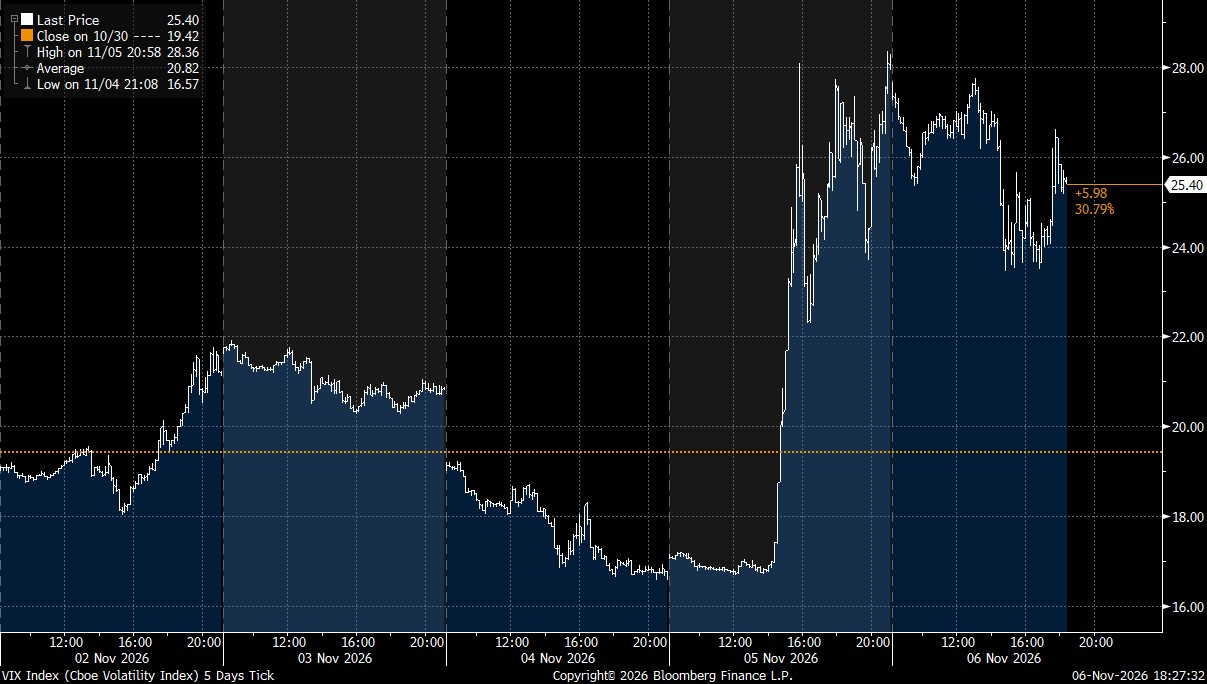
2. From rotation to volatility shock. After the blue wave, the stock market’s selloff in “Trump winners” morphed into a volatility shock. We had 3 unwinds: systematic and leveraged investors became heavy sellers, possibly joined by retail, which explains Thursday’s indiscriminate unwind. On our intraday VIX chart, you can see the big move started at the US open on Thursday. Barclays adds that we may not be through all the systematic selling yet, but we should be approaching levels where risk-reward starts to improve. By Friday, dip buyers returned: the Philadelphia Semiconductor Index jumped 4.2% and the Nasdaq 100 recovered 1.35% on the day.

3. Oil’s historic swing. Crude was the most volatile asset of the week. Oil plunged nearly 9% on Wednesday as the Democratic sweep raised expectations of a softer US stance on the Iran war, which proved deeply unpopular with voters. President Trump indicated no immediate plan to attack Iran, and senior administration officials acknowledged oil prices played a role in the poor Republican results. Brent rebounded nearly 4% on Thursday as doubts about peace progress persisted, but front-month futures were still down around 15% at one point. Vitol’s CEO estimated global oil demand could drop by around 3 million barrels per day in 2026 because of the war’s economic toll.
4. A strong jobs report. October payrolls showed 165,000 jobs added, far above the ~65,000 consensus, with unemployment steady at 4.1%. That reinforced expectations of a Fed hike at the 9 December meeting. Cleveland Fed President Hammack and St. Louis Fed President Musalem both signalled that rates need to move into restrictive territory. Musalem specifically flagged AI infrastructure spending as an inflation driver.
5. Central banks elsewhere. The Bank of England hiked 25bp to 4.0% in an 8–1 vote, with one member wanting 50bp, and warned that inflation is on track to hit nearly 5% next year. Traders added to bets on another BoE hike in December. ECB President Lagarde warned that inflation is “likely to remain high in the near future.” In Japan, government bonds rallied hard: the 10-year JGB yield fell 12bp to 2.635%, and the odds of a December BoJ hike dropped to about 52%.
Asset & Sector Performance: How the Blue Wave Hit the Stock Market

Europe held up. Its low exposure to AI and the post-election drop in oil helped the region outperform the US. The Stoxx 600 finished up 0.2%, holding above its 200-day moving average. Lower oil would also ease pressure on stretched bond markets like France and Italy. Asia took the hit instead: the Nikkei and KOSPI were the worst major markets, given their heavy semiconductor exposure.
Gold surged as a haven, up more than 5% on the week. The metal had been heading for its worst annual performance in over a decade, falling from a record above $5,500 earlier in the year to below $4,000. The US dollar was a touch firmer. It dipped on Wednesday as traders priced in gridlock but stabilised by Thursday, less than 1% below an 18-month high.
Industries: The YTD winners were the big underperformers. Semiconductors fell more than 10%, joined by oil services, energy, cybersecurity and data-centre names. The winners were the laggards: gold miners, silver, airlines (lower fuel costs) and solar.

Sectors: Technology fell about 8% and Energy more than 12% with crude. Telecoms (+4.4%), Consumer Discretionary (+2%), Financials and Materials were up. That’s the affordability and consumer trade the market is starting to price.

Biggest S&P 500 movers of the week:

AppLovin (+71%) was the runaway winner in both indices after a blowout earnings report, with its AI-powered advertising platform continuing to gain market share. Payments (Fiserv, Corpay +13.5%), health care (IDEXX, Moderna +15%), Mosaic and consumer travel (Airbnb, Booking) also rallied. First Solar (+15%) gained, potentially on policy tailwinds from the Democratic sweep.
The losers were concentrated in storage and semiconductors: Seagate, Western Digital, Sandisk, Marvell, Microchip (-25%) and Ciena (-24%), all hit by concerns about AI capex. Datadog (-24%) was the notable software casualty. In the Nasdaq 100, Lumentum (-36%), Astera Labs (-26%) and Micron (-22%) extended the chip pain.
Rates & Fed Expectations: Bonds Keep Working as a Hedge
Recently, bonds have been working better as a flight to safety, and this week confirmed it. Yields fell across the board, led by Europe as oil dropped:

Italy (-19bp) and France (-17bp) led the rally. Lower oil directly eases the fiscal and inflation pressure on Europe’s most stretched balance sheets.
Fed expectations: The odds of a +25bp hike in December are now about 78%, helped by the strong payrolls and hawkish Fed speakers. December 2027 fed funds futures sit at 4.33%, about 45bp above the current effective rate.
Volatility & Technicals: The Levels That Matter
VIX at 25.6. The blue wave turned into a volatility event for the stock market. That’s a big move, with most of it starting at the US open on Thursday. On the chart since January 2022, it’s one of the sharpest spikes of the past few years. The SPY weekly straddle is now ±2.6% and QQQ ±3.9%, much wider than the ±1.2–1.9% of recent weeks.

S&P 500: As flagged before, ~7,300 is important support. If that breaks, there isn’t much support before 7,000. Below that, we’d be talking about a big correction towards the long-term trend at 5,800–6,000.
Nasdaq 100: 26,100 is the support. If we go lower, it’s the unknown.
Factors: The rotation shows up clearly in the factor baskets. Laggards, value and consumer exposures led, while AI, momentum and high-beta baskets were hit hardest.
Flows: Despite the volatility, EPFR data via Barclays shows a sixth straight week of global equity inflows, with record weekly inflows into Emerging Markets. Year-to-date equity inflows have reached a record $1.2 trillion, versus just over $800 billion for fixed income. This week, though, money-market funds and bonds took the largest inflows, a classic risk-rebalancing signal.
Earnings Checkpoint: Late-Season AI Tests
The bulk of Q3 earnings season is behind us, and the message is unchanged: earnings growth is strong, but no longer accelerating. Stocks that miss, especially in tech, are punished hard. This week, AppLovin showed what a beat in AI-driven revenue still earns, while Datadog showed the opposite.
Next week’s highlights: AI infrastructure names come back into focus, with CoreWeave, Nebius and Cerebras reporting. Given the credit and capex concerns, those results will be closely watched. Cisco and Occidental also report, as do Barrick, Sea, Nu Holdings, monday.com, Rigetti and Petrobras.
The Week Ahead: CPI, Twenty Fed Speakers and Long-End Supply
- Mon 9-Nov: Wholesale Inventories; China CPI (cons. 0.8% vs 0.9%), PPI and M2; Japan Leading Index; 3-year Treasury auction ($58bn)
- Tue 10-Nov: US CPI (cons. +0.3% m/m vs +0.6%); NFIB Small Business Optimism; China Trade Balance; 10-year auction ($42bn); seven Fed appearances, including Waller, Logan, Schmid, Bowman and Barr
- Wed 11-Nov: No Fed speakers; German CPI; Italian Industrial Production; China’s Singles’ Day shopping event
- Thu 12-Nov: Existing Home Sales; UK GDP and Industrial Production; Japan PPI (cons. 6.5% vs 6.8%); 30-year auction ($25bn); Fed’s Goolsbee, Daly, Schmid and Williams
- Fri 13-Nov: US PPI; Eurozone GDP; France and Spain CPI; Fed’s Collins, Bowman and Jefferson
CPI is the single most important data point of the week. After two months of uncomfortably high readings, including a 0.6% month-on-month surge in September, consensus expects a moderation to 0.3%. An upside surprise would likely amplify December hike bets and put further pressure on risk assets.
Also on the radar:
- The IEA, OPEC and EIA monthly oil market reports, which matter more than usual after oil’s extreme volatility
- The Iran war and any peace headlines
- About €14 billion of European government bond auctions, including Germany and Italy
- The COP31 climate conference in Turkey
- New Zealand’s general election results
Twenty Fed appearances in one week, plus heavy Treasury supply, mean rates volatility could stay high.
Trader’s Note: The blue wave didn’t change earnings overnight, but it changed the story the stock market is willing to pay for. Crowded AI winners are being sold to fund the consumer, affordability and laggard trade, and the volatility shock forced systematic sellers out on Thursday. With the VIX at 25 and straddles at 2.6% for SPY and 3.9% for QQQ, levels matter more than narratives: 7,300 on the S&P and 26,100 on the Nasdaq. Hold them and Friday’s dip buyers have a case. Lose them and the next stop is 7,000. Tuesday’s CPI decides which.
Stay Connected
Want to dive deeper or join the community?
📧 Mentoring for Q1 2027 is now open for bookings. Places are limited: https://duponttrading.com/mentoring/
🎥 Access the 4×4 video series: https://duponttrading.com/4×4-course/
💬 Join the Discord: a free channel plus ~20 paid channels of trading insights: https://discord.com/invite/Yf42SgAx7f
For any questions or to join our mentoring sessions, email us at Greg 📩 Contact: greg@duponttrading.com
Have a good Trading Week!
Sub Section Title Here
Lorem ipsum dolor sit amet, consectetur adipiscing elit, sed do eiusmod tempor incididunt ut labore et dolore magna aliqua. Ut enim ad minim veniam, quis nostrud exercitation ullamco laboris nisi ut aliquip ex ea commodo consequat. Duis aute irure dolor in reprehenderit in voluptate velit esse cillum dolore eu fugiat nulla pariatur. Excepteur sint occaecat cupidatat non proident, sunt in culpa qui officia deserunt mollit anim id est laborum.
THIS POST

LEARN ONLINE TRADING TODAY. THE PROFESSIONAL WAY.
Let us solve the problem and confusion around trading and finance management, the right way.
ACCESS FREE LECTURESUBSCRIBE
TO OUR BLOG
To receive opinions, market research, and data analysis in the Financial Markets
ABOUT
DUPONT TRADING
As a Professional Trader/Portfolio Manager/Hedge Fund Manager for almost 20 years, I know that learning how to Trade/Invest is a non-ending learning curve. This adventure is extremely exciting but needs to be ridden carefully.
In January 2018 after receiving many requests, I decided to start my own mentoring activities.
In October 2019, I launched the 4×4 Video Series to help Investors profitably manage their portfolios. By sharing my ideas/experiences and offering education through the 4×4 Video Series, I hope I can help you becoming a better investor.

Students
Testimonials

T. (France)
LEARN ONLINE TRADING TODAY. THE PROFESSIONAL WAY.
Let us solve the problem and confusion around trading and finance management, the right way.