
The AI Unwind: Semis Down 10%, Oil Up 10%, and Bonds Are a Hedge Again
This was the week the AI trade cracked. An AI stocks selloff that started in chipmakers and data-centre suppliers spread across the whole AI complex. The Philadelphia Semiconductor Index fell more than 12%, its longest chip selloff since 2006. The Nasdaq 100 dropped 5.5%, Korea’s KOSPI collapsed 14.5%, and the S&P 500 lost 1.9%, ending a 53-session streak without a 1% daily decline (the longest since January 2020).
The backdrop didn’t help. US CPI and PPI both came in hot, Brent touched $110 and WTI rose more than 10% on the week. Yet the US 10-year yield fell 17bp. As I said last week, it felt like bonds were bottoming. This week, Treasuries finally worked as a safe haven again. Meanwhile, volatility woke up just as we discussed in the midterm election webinar: the VIX jumped to 20, with a big move on Friday.
Macro Catalysts: Hot Inflation, Hotter Oil, Cold AI
The AI stocks selloff. Several things hit at once:
- Credit stress. CoreWeave fell more than 20% after its co-founder indicated the data-centre operator was exploring investment-grade debt markets for financing. Its junk bonds yielded around 15%, a level usually associated with distress, and high-yield markets started freezing out AI and tech start-ups seeking funding. Goldman Sachs notes USD high-yield spreads widened more than 20bp over two weeks, with the pressure concentrated in AI-related issuers.
- Funding and valuation worries. A couple of Asian data-centre companies delayed their IPOs.
- Memory competition. Concerns about intensifying competition in the global memory sector hit Korean stocks especially hard.
- The monetisation question. Investors keep asking whether huge AI capex is turning into real revenue for the leading AI model developers.
The positioning, not a breakdown in fundamentals, drove most of the move. Guidance from both ASML and TSMC was strong this week, and earnings expectations are holding up. But with semis and tech hardware now a record 25% of MSCI All Country World market cap, double the share of five years ago, profit-taking on any negative headline can turn into an indiscriminate unwind. Systematic investors remain very long.
Inflation is back in the driver’s seat. Hotter-than-expected US CPI and PPI prints revived fears that the Fed has limited room to ease, and they added fuel to the tech selloff. Cleveland Fed President Hammack warned that repeated supply shocks could entrench an inflationary mindset among businesses, and San Francisco Fed President Daly also flagged concern about persistent inflation. On the fiscal side, US government net interest costs hit a record $1.05 trillion for fiscal year 2026, up more than 8% year on year.
Oil: a fresh shock. Renewed Middle East tensions pushed WTI up 10.4% on the week, and Brent reportedly touched $110 a barrel. That’s a new inflationary impulse just as the Fed was hoping for relief.
Europe was the winner. The Stoxx 600 rose about 2.1%, its best week since July and its biggest outperformance versus the S&P 500 since April 2025. The FTSE 100 gained 3.1%. Europe has plenty of near-term headwinds (oil, rates, politics, fiscal worries), but AI and tech concentration is not one of them. That makes it a good diversifier if the AI trade keeps unwinding.
Asset & Sector Performance: The AI Stocks Selloff Hits Tech
The S&P 500 fell 1.9%, the Nasdaq Composite fell about 4.5% and the Russell 2000 about 3%. Asia took the brunt: the KOSPI fell 14.5%, the Nikkei 5.4% (dragged lower by its semiconductor heavyweights) and MSCI Emerging Markets about 5%. In Europe, the FTSE 100 (+3.1%) and Stoxx 600 (+2.1%) rose. Gold slipped slightly, Bitcoin fell about 3%, the dollar was a touch weaker, and WTI was the standout at +10.4%.

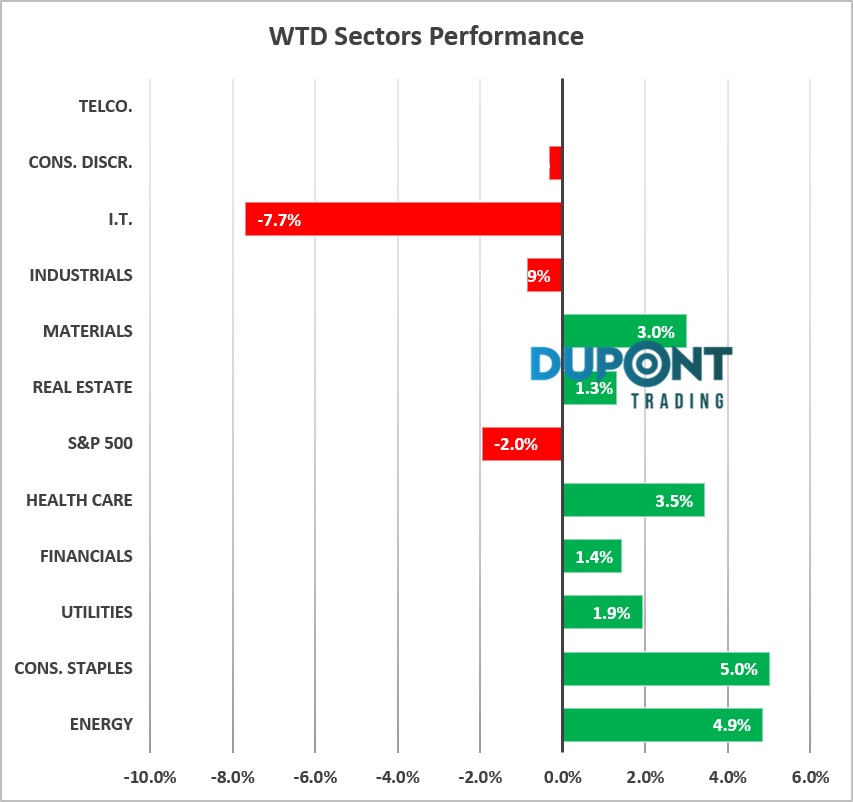
Sectors: one picture says it all. Technology fell about 7.7% on the week and dragged the S&P 500 lower. Defensives led: Consumer Staples (about +5%), Energy, Health Care and Materials all posted solid gains. At the industry level, semiconductors fell more than 10%. Cybersecurity, digital infrastructure, cloud, nuclear and solar were also among the worst. Consumer staples, energy, insurance, food & beverage and health care led on the upside.

Factors confirm the rotation. Long value/short growth, long quality/short junk and inflation-sensitive baskets were among the best performers. Memory, high-beta momentum, US data centres and AI electrification beneficiaries were the worst. Goldman Sachs’ Momentum factor fell 8% this week. Its Cyclicals vs. Defensives pair is down 6% over the past two weeks, while the S&P 500 ex-AI has rallied 4% over the same period. GS also notes that hedge funds sharply cut their net leverage and their AI positioning.
Biggest S&P 500 movers of the week:

The losers show how concentrated the AI stocks selloff was: almost entirely AI infrastructure and hardware: Dell (-23%), Bloom Energy (-21%), Everpure (-20%) and Teradyne (-19%) rounded out the bottom ten. The winners tell the rotation story: IT services and insurance/data analytics (Accenture, Cognizant, Arthur J. Gallagher, Erie Indemnity) plus defence, with Lockheed Martin and Northrop Grumman up 8–10%. FICO bounced 16% after last week’s 23% collapse.
In the Nasdaq 100, CoreWeave (-21%) led the declines, tied directly to the credit stress, with Rocket Lab and Nebius each down about 20%. Lumentum, Marvell, Teradyne, Seagate, Palo Alto, CrowdStrike and Western Digital were also among the worst. The gainers were mostly consumer staples (Walmart, Keurig Dr Pepper, Monster Beverage, Coca-Cola Europacific Partners, Starbucks) plus Intuit and IDEXX. That’s a clear flight to quality within the index.
Rates & Fed Expectations: Higher Inflation, Lower Yields
This was a very interesting week for bonds. Inflation came in hotter and oil spiked, yet yields went lower. The AI-driven risk-off move drove a flight to safety into Treasuries, more than offsetting the inflation pressure from oil.

10-year has fallen more than 20bp over the past two weeks, after climbing more than 100bp over the prior six months. Bonds can still act as a hedge. It doesn’t make sense to worry about both the AI trade and rising yields at the same time, because the two go hand in hand. Investors should be careful what they wish for.
Fed expectations: No hike is priced for the 28–29 October meeting, but markets still price a 25bp hike in December. Fed funds futures for December 2026 sit at 4.08%, versus an effective rate of 3.88%. The Fed is now in its blackout period, so there will be no Fed speakers this week.
Elsewhere: At the IMF Annual Meetings, ECB officials signalled that a December hike is the most likely next move, with October possible but less likely. In the UK, September CPI is expected around 3.4%, a nine-month high, which could seal a Bank of England hike in November.
Volatility & Technicals: The Low-Vol Regime Breaks
VIX: Finally, as discussed during the midterm election webinar, volatility has been moving up. The VIX closed the week at 19.99, up 2.9 points on the week and 5 points year to date, after a big intraday spike on Friday. Bloomberg notes that traders are increasingly positioning for the low-volatility environment to break down more broadly.
Straddles: The SPY weekly straddle is pricing about ±1.6% for next week, and QQQ about ±2.6%. Both are a step up from the ±1.2–1.3% we’ve seen in recent weeks.
Breadth: With the S&P 500 just 2% from its record high and the median S&P 500 stock 15% below its own high, breadth remains near its narrowest since the Dot-Com Bubble. Goldman Sachs points out that narrow breadth usually resolves through a reversal of Momentum, either a “catch-down” by the leaders or a “catch-up” by the laggards. This week we got the catch-down.
Flows: Global equity funds took in $65 billion, led by the US ($39bn) and EM ($18bn). Technology attracted nearly $30bn, almost half of all equity inflows, so investors were buying the dip. Year-to-date equity inflows are now $995 billion, closing in on $1 trillion. Money market funds saw $53bn of outflows.
Earnings Checkpoint: Lower Beats Than Usual
With 45 of 500 S&P 500 companies reported, the early read on the Q3 season is softer than recent quarters:
- Sales surprise: 55.5% of companies have beaten on revenue.
- Earnings: 80% have beaten on EPS. That sounds strong, but the average size of the beat is much smaller. Bloomberg data shows the average Q3 earnings surprise at about 4%, versus well into double digits in the first half of 2026.
- Goldman’s stricter measure: only 53% of firms have beaten consensus by more than one standard deviation, above the 25-year average of 50% but well below the 64% average of the past four quarters. Revision breadth has also declined in recent weeks.
The banks had a mixed start. Barclays notes the
This week is busy, and it’s the real AI test:
- Tue 20-Oct: GE Aerospace, GM, RTX, Northrop Grumman, 3M, MSCI, Halliburton; after the close: Netflix, Capital One, Chubb, United Airlines
- Wed 21-Oct: Abbott, AT&T, NextEra, Thermo Fisher, Danaher, CME Group; after the close: Tesla, Meta, IBM, Texas Instruments, Lam Research
- Thu 22-Oct: Comcast, Dow, Nokia, American Airlines, Valero, Huntington; after the close: Western Digital, Newmont, Bloom Energy
- Fri 23-Oct: American Express, SLB, Booz Allen
The best of the AI trade may be over, but with most of the reporting season still ahead, it’s too early to throw the baby out with the bathwater. Mega-cap tech earnings will be key over the coming weeks.
The Week Ahead: Housing, Flash PMIs and a Fed in Blackout
- Mon 19-Oct: NAHB Housing Market Index; China Q3 GDP (cons. 4.4% vs 4.3%), Retail Sales and Industrial Production; UK Rightmove House Prices
- Tue 20-Oct: Housing Starts (cons. +1.9% m/m vs -2.6%) and Building Permits; German ZEW; German PPI; UK Unemployment
- Wed 21-Oct: UK CPI and PPI; Japan Trade Balance; 20-year bond reopening auction ($13bn)
- Thu 22-Oct: Leading Index; Eurozone Consumer Confidence; French Manufacturing Confidence; 5-year TIPS auction ($26bn)
- Fri 23-Oct: Flash Manufacturing, Services & Composite PMIs (US, Eurozone, UK, Japan); University of Michigan Sentiment; Japan CPI (cons. 2.2% vs 1.9%); UK Retail Sales and GfK Consumer Confidence
- Sat 24-Oct: 2nd EU-GCC Summit
Also on the radar: Canada CPI ahead of a possible Bank of Canada hike, ECB and BoE speakers, and as always oil and Middle East headlines.
No Fed speakers this week, as the Fed is in its blackout period ahead of the 28–29 October meeting.
Three themes to watch:
- Does the AI stocks selloff stabilise, or spread further into high-yield credit and the broader equity market?
- Oil at $110: any further move higher would intensify stagflation concerns.
- Do Treasuries keep working as a hedge?
Trader’s Note: When inflation surprises higher, oil jumps 10% and the 10-year still falls 17bp, the bond market is telling you it’s more worried about growth and the AI funding chain than about inflation, at least for now. Positioning was the fuel behind this AI stocks selloff. Systematic and hedge fund longs in AI were crowded, and the unwind was violent. With Meta, Tesla and Lam Research reporting on Wednesday and the VIX back near 20, size positions for a market that can move 1.5–2.5% a week again, and remember that Europe and defensives just showed they can act as a real diversifier.
Stay Connected
Want to dive deeper or join the community?
🤖 AI webinar on 7 November. How I use AI every single day to build my own trading tools, from alerts to macro dashboards. Register here: https://duponttrading.com/how-i-use-ai-every-day-as-a-trader/
🗣️ Weekly community call on Discord (members only), to share ideas, ask questions and learn how to build your own trading infrastructure.
📧 Book mentoring for Q4 2026: https://duponttrading.com/mentoring/
🎥 Access the 4×4 video series: https://duponttrading.com/4×4-course/
💬 Join the Discord: 30 channels of trading insights: https://discord.com/invite/Yf42SgAx7f
For any questions or to join our mentoring sessions, email us at Greg 📩 Contact: greg@duponttrading.com
Have a good Trading Week!
Sub Section Title Here
Lorem ipsum dolor sit amet, consectetur adipiscing elit, sed do eiusmod tempor incididunt ut labore et dolore magna aliqua. Ut enim ad minim veniam, quis nostrud exercitation ullamco laboris nisi ut aliquip ex ea commodo consequat. Duis aute irure dolor in reprehenderit in voluptate velit esse cillum dolore eu fugiat nulla pariatur. Excepteur sint occaecat cupidatat non proident, sunt in culpa qui officia deserunt mollit anim id est laborum.
Related Articles
Webinar: How I Use AI Every Day as a Trader
>> Register here << Date: Nov 07, 2026 Time: 01:00 PM London –…
VIEW POST
Earnings Fever: The Q3 Earnings Season Kicks Off With Record Highs, 5% Yields and Europe Under Stress
The Q3 earnings season starts on Tuesday, and expectations are sky-high. Consensus is…
VIEW POSTTHIS POST

LEARN ONLINE TRADING TODAY. THE PROFESSIONAL WAY.
Let us solve the problem and confusion around trading and finance management, the right way.
ACCESS FREE LECTURESUBSCRIBE
TO OUR BLOG
To receive opinions, market research, and data analysis in the Financial Markets
ABOUT
DUPONT TRADING
As a Professional Trader/Portfolio Manager/Hedge Fund Manager for almost 20 years, I know that learning how to Trade/Invest is a non-ending learning curve. This adventure is extremely exciting but needs to be ridden carefully.
In January 2018 after receiving many requests, I decided to start my own mentoring activities.
In October 2019, I launched the 4×4 Video Series to help Investors profitably manage their portfolios. By sharing my ideas/experiences and offering education through the 4×4 Video Series, I hope I can help you becoming a better investor.

Students
Testimonials

T. (France)
LEARN ONLINE TRADING TODAY. THE PROFESSIONAL WAY.
Let us solve the problem and confusion around trading and finance management, the right way.