
Hedge Funds Dump AI Stocks: Alphabet’s Record Drop, Gold Breaks Down and the Midterms Arrive
The S&P 500 lost only about 0.6% this week, but almost all of it came on Friday, when the index fell 2% and the Nasdaq around 4%. Behind the move is the theme we discussed last weekend: hedge funds de-grossing out of AI. Alphabet suffered a record 13% one-day drop, Intel fell 28% after its guidance, Reddit lost 36%, and semiconductors shed roughly $1 trillion in market value on Friday alone. The Nasdaq 100 is now about 10% below its October peak, in correction territory for the third time this year.
Now the focus turns to Tuesday. The midterm elections are the next big test for the stock market, and they come in a week that also brings PMIs, payrolls, a Bank of England decision and earnings from Apple and AMD.
Macro Catalysts: AI De-Grossing, Hyperscaler Cash Burn and the Search Shock
1. Hedge funds are dumping AI. A Morgan Stanley chart shows this year’s unwind of hedge fund equity exposure is the biggest since 2017. To understand why that matters, you need the difference between net and gross exposure:
- Net exposure = longs minus shorts.
- Gross exposure = longs plus shorts.
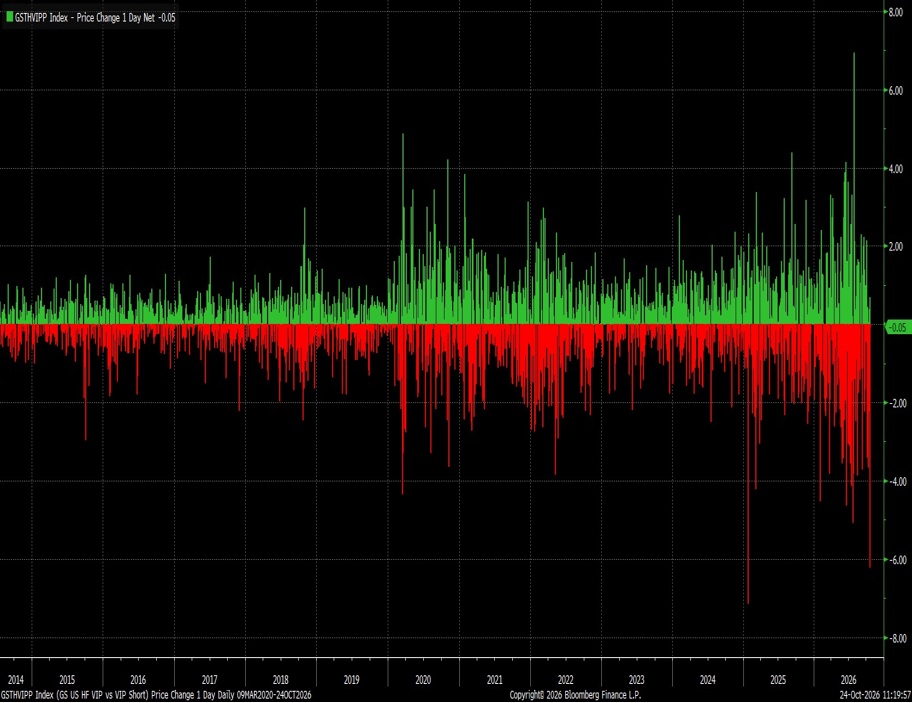
When I was at a hedge fund, running 300–500% gross was normal. Be 200% long and 200% short, and you’re running 400% gross. Funds ran big gross books because volatility was low and leverage from prime brokers was cheap. Over the last few months, that gross exposure has been cut massively. Over the past two to three weeks, that has meant selling the winning trades: momentum, AI and AI infrastructure. That’s exactly what we saw on Thursday and especially Friday.

Source: Morgan Stanley
2. Hyperscalers are burning cash. Wednesday’s FOMC was a non-event. The real move came after the close, with Alphabet and Reddit. Goldman Sachs has a great chart showing how the hyperscalers have gone from positive to negative free cash flow over the last two to three quarters. The market’s message is simple: as long as you plan to run negative cash flow, your stock will be under pressure. Alphabet fell a record 13% on Wednesday’s results, the second-largest one-day market cap wipeout in US history, on fears that AI spending is cannibalising returns.
The demand side looks fine. Goldman notes cloud revenue at Amazon, Alphabet and Microsoft grew 54% year on year in Q3, which is real evidence of returns on AI investment. But the bill keeps rising. Hyperscalers are on track for roughly $800 billion of capex this year (+96%), and analysts expect $1.2 trillion in 2027 (+44%). Barclays sums it up: deteriorating cash flows plus rising capital commitments mean the debate over AI returns “may not be resolved anytime soon.”

3. Reddit and the search shock. Reddit fell 25–30% on Friday, into the low $90s, and 36% on the week. It told us something important. Before AI, Google search would quickly send users to sites like Reddit. Now the business model of the AI platforms and hyperscalers is to keep users on their own platform and answer the question there. Many businesses were built on the assumption that search would send traffic their way. That’s not working anymore. This goes well beyond Reddit: many internet businesses will be affected.
4. Intel and the semis. Intel plunged more than 28% after guiding Q4 revenue to $15–16 billion, well below the ~$17 billion consensus. That was its worst drop in over four decades. Semiconductors collectively lost about $1 trillion in market value on Friday. Ironically, the week had started on a positive note: Anthropic’s IPO filing on Monday revealed $16.3 billion of first-half revenue, lifting the Philadelphia Semiconductor Index about 3%.
5. The financing loop. As we discussed last week, valuation drives collateral, and collateral drives capex. Say an AI lab can raise $30 billion of equity at a $1.5 trillion valuation, but only $20 billion at $1.2 trillion. Less equity means less debt it can raise against it, and less money for capex. Whether Anthropic can IPO successfully, and at what valuation, matters for the whole AI chain. I think the IPO will happen unless markets go down the toilet.
Crypto: Bitcoin fell about 8% on the week. A record hack at a major exchange, with withdrawals frozen for days, is not a great look for an asset class that claims to be safer than fiat money. In 2026 we are still dealing with multi-billion-dollar losses, and you can’t withdraw your money. Fiat money is still the best in town.
Brazil: Lula’s unexpected election win made Brazil the week’s biggest loser, and Brazilian financials were smashed on Monday. We flagged the election last weekend, and there were good trades to be had.
Macro data: GDP was solid at more than 3%, but there are signs that growth will be harder to get going forward. PCE came in roughly in line, with inflation still running hotter than the Fed would like. US consumer sentiment slipped to a five-month low.
Asset & Sector Performance: Tech Down, Everything Else Up
The S&P 500 fell about 0.6%, with most of the damage on Friday (-2%). The Nasdaq underperformed. Europe outperformed: the Stoxx 600 gained 1.7% and the DAX 1.6%, as its low exposure to the AI mega-caps finally became a strength. Health care and defensives cushioned the Thursday–Friday tech selloff, and UK bank stocks got a boost after the budget raised the bank surcharge by less than feared.
Currencies were broadly flat, and the dollar index was little changed. Bitcoin and Ethereum fell. Gold fell about 3% to a one-year low near $3,876, its worst October since 2008, hit by inflation fears and forced selling to cover equity losses. WTI edged up about 0.8%.
Industries: Silver was the biggest loser, under pressure on Thursday and Friday from both de-grossing and the move in yields. Internet and social media were crushed by AppLovin, Reddit and Alphabet, which fell between 10% and 36%. On the right side of the chart, pharma and biotech kept doing very well. That’s a mix of defensive buying and the way AI is helping the space make new discoveries.

Sectors: Tech fell about 2%, and Communication Services was hit by Alphabet, Reddit and AppLovin. Almost every other sector was up, with cyclicals like Industrials and Materials nicely higher. That’s a broadening of performance outside tech.
Since the start of Q3 earnings season, 70% of S&P 500 companies have posted positive returns, but they account for only 50% of market cap. As a result, the S&P 500 is down 3% since the season began, while the S&P 500 ex-AI is up 5%.
Biggest S&P 500 movers of the week:

The losers are dominated by tech, software and cybersecurity: Reddit, ServiceNow, F5, Fortinet, Intel, Twilio (-22%), Marvell (-14%) and HP (-14%). The gainers are spread across sectors. Industrials (Pentair, Huntington Ingalls), consumer names (Carvana, Chipotle, Norwegian Cruise Line), Regeneron in health care and General Motors all rallied. Global Payments jumped on reports that CD&R is weighing a buyout. Vertiv (+20%) stands out because it’s a data-centre infrastructure name, a sign of differentiation even inside the AI complex.
In the Nasdaq 100, Alnylam (-26%), Fortinet, Intel, Marvell, Datadog, Alphabet (-12%), AppLovin and Teradyne led the losses. Regeneron (+15%), Ferrovial, Lumentum, Moderna, NXP and Tesla (+7%) led the gains.
Rates & Fed Expectations: The Flight to Quality Continues
The US 10-year now sits at 4.93%, roughly 40bp below its high. Three weeks ago, I said that despite inflation prints coming in a bit hotter than expected, we were seeing a flight to quality. That has continued. The market is worried about two things:
- AI financing becomes a struggle, so companies can’t do as much capex as they wanted a few months ago.
- As a result, growth expectations come down and the Fed doesn’t need to hike as aggressively as expected six weeks ago.
The Fed held rates steady on Wednesday. Chair Warsh signalled the hiking cycle isn’t over, citing a strong economy and persistent inflation. Markets now price about 18bp for December, roughly a 70% chance of a hike. Further out, pricing for next year has come down about 18bp since the start of September, almost one hike less than two months ago.
With hawkish Fed rhetoric, elevated oil and lingering AI capex worries, bonds are working again as diversifiers.
Volatility & Technicals: Monthly Charts Tell the Story
VIX: It’s at 19.4, after a spike this week as the stock market prices the midterm elections. A month ago, I explained why going long volatility into the midterm elections made sense, and you can see the midterm bump in the November VIX futures. Historically, volatility tends to get compressed after the vote, once the outcome is known.
Monthly charts. Monthly charts give you a wider picture of what the market is telling us.
- S&P 500: It has traded in a roughly 200-point range for four to five months, with some recent rejections and indecision. That’s not the end of the world. We’re still in the trend, but we can’t find more momentum.
- Nasdaq: It’s the same picture, chopping for about six months with roughly twice the volatility of the S&P. We’re right in the middle of the range. No panic yet.
- Magnificent 7: A volatile week, a big candle and a bit of a rejection, but nothing is broken. We’re testing support, and the trend is still your friend.
Gold: Last weekend we flagged $3,960 as a big level. It broke. There isn’t much support now until around $3,500. In the Discord community I’ve been discussing 3-month put spreads: with a quarterly ATR of roughly 12–15%, a move towards $3,800–3,200 is plausible. You can express it through the GLD ETF.
Silver: A very clean downtrend that has been easy to trade. Friday alone offered an easy 3% move.
Bitcoin: The chart isn’t horrible yet, but this week’s big candle doesn’t help. There’s a chance it goes back towards $65,000.
Earnings Checkpoint: Strong, But No Longer Accelerating
With 60% of S&P 500 companies reported, Q3 EPS growth is tracking 33% year on year. That matches Q2 as the strongest quarter in decades outside post-recession recoveries, but it ends the pattern of acceleration.
- Beats: 60% of companies have beaten by more than one standard deviation, versus 64% over the past four quarters. The size of the beats has been smaller than in recent quarters.
- Revisions: 2027 consensus EPS is up 2% since the season started, but revision breadth has moderated. Analysts have trimmed margin estimates because of energy prices.
- AI infrastructure earnings growth is peaking at about 80% this quarter, slowing to roughly 40% in 2027.
My read: this earnings season has been OK but not great. The beats are smaller than over the past one to two years, and companies that miss on earnings or sales are being punished hard. The quality of earnings isn’t as good as before.
Hedge funds have cut their gross exposure a lot, but we haven’t seen the second-round effect yet. The S&P’s forward P/E has already de-rated from 22x to 19x. The question is whether the AI slowdown turns into lower earnings growth.
Next week: Earnings collide with the midterm elections, a rare double test for the stock market. 143 companies, about 21% of S&P 500 market cap, report. The headliners are Apple (the last of the Magnificent 7) and AMD, both after the close on Monday, just before the vote. Apple’s capex commentary will be closely watched given the AI cash-burn narrative.
The Week Ahead: Midterm Elections, the Stock Market and Payrolls
- Mon 2-Nov: ISM Manufacturing (cons. 54.7 vs 54.5); global Manufacturing PMIs (US, Eurozone, UK, Japan, China); Construction Spending; Apple and AMD after the close
- Tue 3-Nov: US midterm elections; Factory Orders; Durable Goods
- Wed 4-Nov: ISM Services; Services & Composite PMIs; Trade Balance; Eurozone CPI (cons. 3.9% vs 3.8%)
- Thu 5-Nov: Bank of England (cons. hike to 4.0% from 3.75%); Eurozone PPI; German Factory Orders
- Fri 6-Nov: Nonfarm Payrolls (cons. +65k vs +29k), Unemployment Rate (cons. 4.2%); University of Michigan Sentiment; Eurozone Retail Sales; German Industrial Production
Also this week: the RBA rate decision and an OPEC+ meeting, where delegates say the group is set to stick with steady quotas. The SPY weekly straddle is at about ±1.9%, roughly the same as last week.
The midterm elections and the stock market. We covered the playbook in our webinar a few weeks ago, splitting it into before, during and after the vote.
- History is supportive. Stocks have historically done well in the 12 months after midterm elections, partly because volatility comes down once the outcome is known.
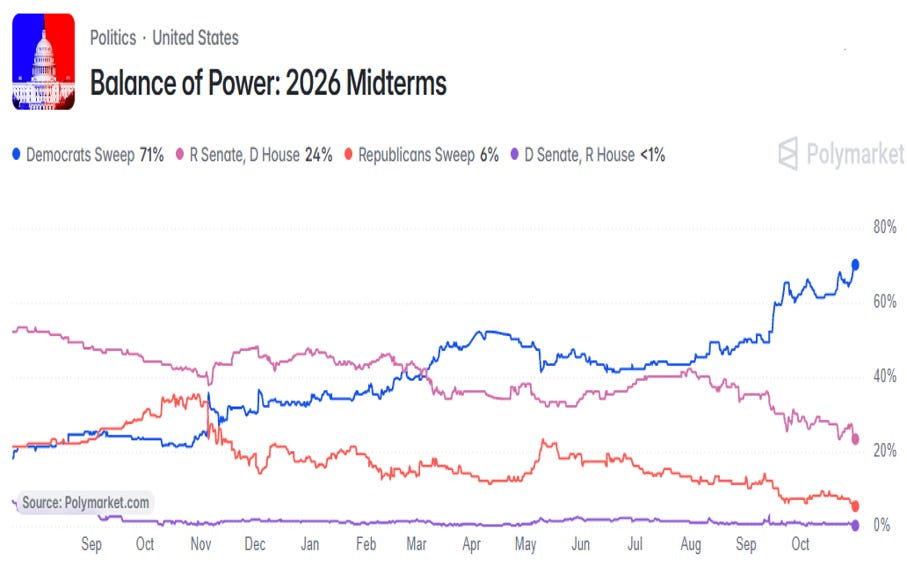
- The risk is a Democratic sweep. Markets usually like a balance between Republicans and Democrats. Prediction markets point to a good chance Democrats win both chambers, which would mean a very different agenda. Barclays’ base case is a divided government, with Democrats favoured in the House and the Senate a toss-up. They note a sweep could bring more regulation for AI (especially data-centre development) and slow bank deregulation. Recent price action, with Tech and Banks lagging and yields lower, suggests markets have already started pricing some of that risk.
- A clearing event. Barclays sees the vote as more likely to be a clearing event than a lasting negative. Buybacks also return once the Q3 blackout ends.
- Seasonality helps. Over roughly the last 30 years, the S&P has risen about 2.3% on average in November and about 1% in December.
- Oil remains the wild card. With the midterms and the Israeli elections out of the way, any renewed escalation with Iran could intensify the energy shock. Iran has already threatened wider strikes on the US, even as talks progress.

Trader’s Note: Heading into the midterm elections, the stock market has already de-grossed a lot, and positioning is much cleaner. But the market hasn’t yet decided whether AI cash burn means lower earnings. That’s the second-round effect to watch. Tuesday’s midterm elections should compress volatility once the result is known, and seasonality into year-end is supportive. But respect the broken levels (gold below $3,960, Bitcoin’s weak candle) and stay balanced between AI and the broadening non-tech trade. If a Democratic sweep lands, expect AI regulation and banks to be the first headlines the market trades.
Stay Connected
Want to dive deeper or join the community?
🤖 AI webinar — Saturday 7 November, 1:00pm London. How I use AI every day for my trading, my education and building my trading infrastructure. Free for paid Discord members, or register here: https://buy.stripe.com/7sY28r6e78HH0vra3P5Rm01
📧 Mentoring for Q1 2027 is now open for bookings. Places are limited: https://duponttrading.com/mentoring/
🎥 Access the 4×4 video series: https://duponttrading.com/4×4-course/
💬 Join the Discord: a free channel plus ~20 paid channels of trading insights: https://discord.com/invite/Yf42SgAx7f
For any questions or to join our mentoring sessions, email us at Greg 📩 Contact: greg@duponttrading.com
Have a good Trading Week!
Sub Section Title Here
Lorem ipsum dolor sit amet, consectetur adipiscing elit, sed do eiusmod tempor incididunt ut labore et dolore magna aliqua. Ut enim ad minim veniam, quis nostrud exercitation ullamco laboris nisi ut aliquip ex ea commodo consequat. Duis aute irure dolor in reprehenderit in voluptate velit esse cillum dolore eu fugiat nulla pariatur. Excepteur sint occaecat cupidatat non proident, sunt in culpa qui officia deserunt mollit anim id est laborum.
THIS POST

LEARN ONLINE TRADING TODAY. THE PROFESSIONAL WAY.
Let us solve the problem and confusion around trading and finance management, the right way.
ACCESS FREE LECTURESUBSCRIBE
TO OUR BLOG
To receive opinions, market research, and data analysis in the Financial Markets
ABOUT
DUPONT TRADING
As a Professional Trader/Portfolio Manager/Hedge Fund Manager for almost 20 years, I know that learning how to Trade/Invest is a non-ending learning curve. This adventure is extremely exciting but needs to be ridden carefully.
In January 2018 after receiving many requests, I decided to start my own mentoring activities.
In October 2019, I launched the 4×4 Video Series to help Investors profitably manage their portfolios. By sharing my ideas/experiences and offering education through the 4×4 Video Series, I hope I can help you becoming a better investor.

Students
Testimonials

T. (France)
LEARN ONLINE TRADING TODAY. THE PROFESSIONAL WAY.
Let us solve the problem and confusion around trading and finance management, the right way.